

Steel Structure Building Advantages: A Practical Guide for Owners and Contractors
Choosing the wrong building system can delay construction, increase site labor, create installation problems, and limit future expansion. For warehouses, factories, workshops, logistics buildings, and industrial facilities, steel structure buildings are often selected because they offer a practical balance between speed, strength, flexibility, and project control.
The main advantages of steel structure buildings include faster construction, large-span space, factory-controlled fabrication, flexible layout, easier expansion, lighter structural weight, and predictable installation when the design, production, packing, and erection process are well managed.
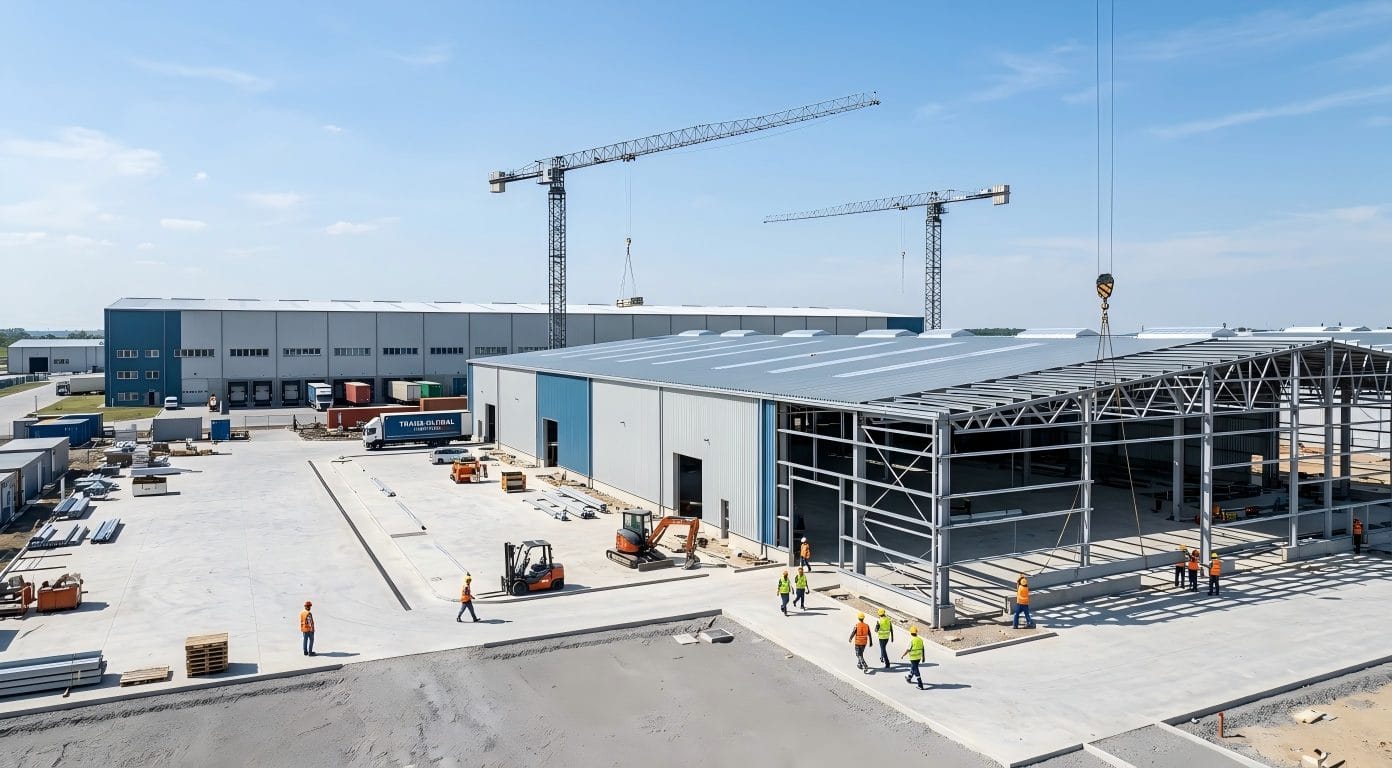
Steel structure buildings should not be viewed only as a material choice. For owners, contractors, and project managers, they are also a project delivery method. The final result depends not only on the steel frame itself, but also on design coordination, fabrication accuracy, welding quality, surface treatment, packing, shipping, labeling, and site installation planning.
This guide explains the key advantages of steel structure buildings from a practical project perspective.
Main Advantages of Steel Structure Buildings
Steel structure buildings are widely used in industrial and commercial projects because they can reduce many common construction risks. The value is especially clear when a project requires fast delivery, open space, factory-made components, or future modification.
| Advantage | Why It Matters | Typical Applications |
|---|---|---|
| Faster construction | Steel members are prefabricated before arriving on site | Warehouses, factories, workshops |
| Large clear span | Fewer internal columns improve usable space | Logistics centers, aircraft hangars, sports halls |
| Factory quality control | Cutting, welding, drilling, blasting, and painting can be inspected before shipment | Export steel buildings, industrial buildings |
| Flexible layout | Steel frames can be designed for different bay sizes, cranes, mezzanines, and equipment | Production plants, workshops |
| Easier expansion | Future bays or extensions can be considered during initial design | Warehouse expansion, factory phase-two projects |
| Lighter structure | Steel’s high strength-to-weight ratio may reduce dead load in many designs | Projects with foundation cost concerns |
| Better site efficiency | Bolted connections and marked members can reduce field work | Projects with limited skilled site labor |
| Recyclability | Structural steel is recyclable and often reused in the steel supply chain | Sustainable building projects |
Structural steel is commonly recognized for its high strength-to-weight ratio, adaptability, and suitability for long-span construction1. However, these advantages depend on proper engineering design, fabrication quality, and site execution.
1. Faster Construction Through Prefabrication
One of the biggest advantages of steel structure buildings is prefabrication. Steel columns, beams, bracing, purlins, girts, and other components are fabricated in the factory before they are delivered to the project site.
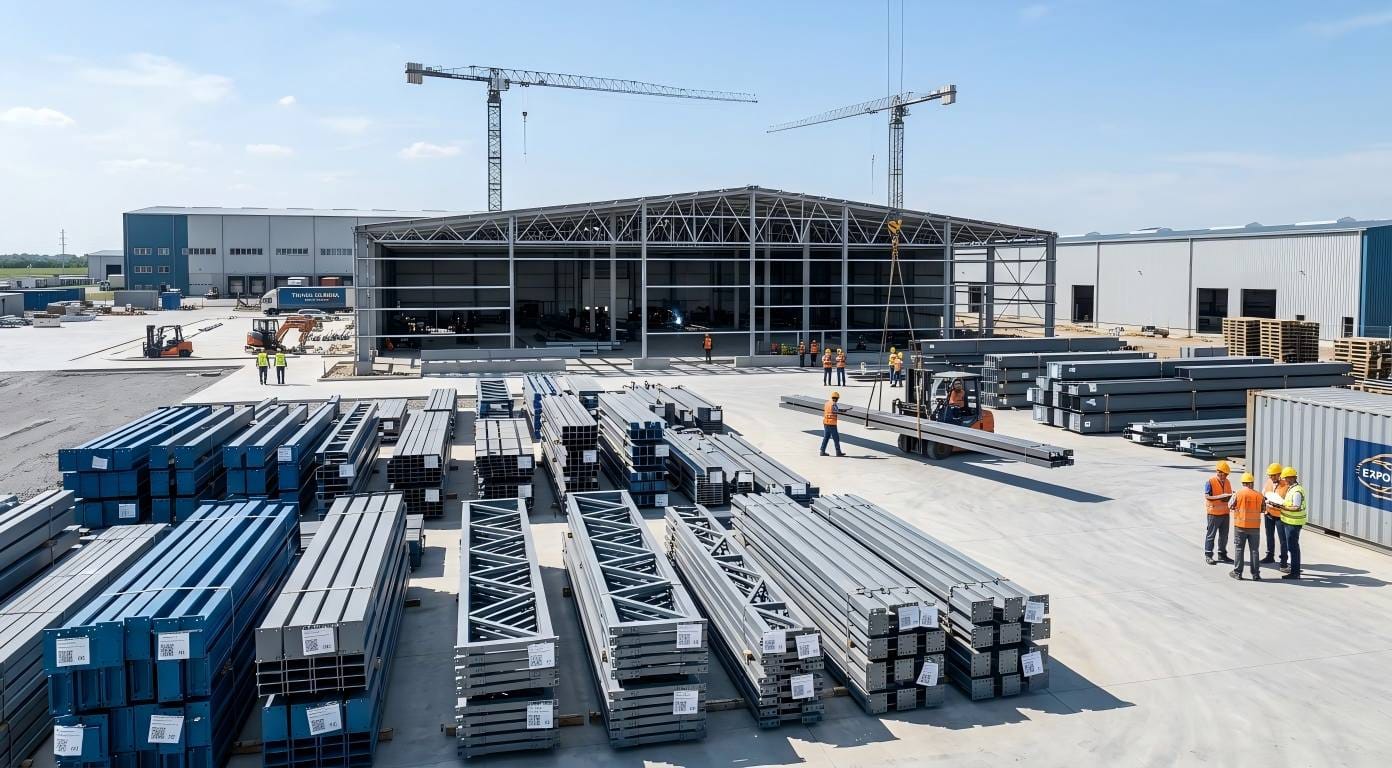
In a well-managed steel structure project, the factory process usually includes:
- Material preparation
- Cutting
- Assembly
- Welding
- Drilling
- Dimensional inspection
- Surface treatment
- Painting or galvanizing
- Component marking
- Packing
- Container loading
This process reduces the amount of fabrication work required on site. Instead of cutting and welding most components at the construction site, the site team mainly focuses on unloading, positioning, bolting, alignment, and final installation.
How Prefabrication Improves Site Efficiency
| Factory-Controlled Work | Site Benefit | Risk If Poorly Managed |
|---|---|---|
| Accurate shop drawings | Components fit according to erection drawings | Rework and installation delay |
| CNC cutting and drilling | Better hole alignment and dimensional control | Site drilling or modification |
| Welding inspection | Fewer welding defects before shipment | Repair work on site |
| Component marking | Installers can identify members quickly | Confusion and lost labor time |
| Packing by sequence | Easier unloading and erection planning | Important parts may be buried in containers |
| Complete bolt packages | Faster installation preparation | Missing bolts can stop erection work |
Prefabrication does not automatically guarantee a fast project. It must be supported by accurate detailing, good communication, correct marking, and practical packing. A manufacturer that understands site erection can help reduce avoidable installation problems.
2. Large Span and Flexible Interior Space
Steel structure buildings are especially useful when the project requires large open space. Warehouses, workshops, factories, and logistics buildings often need wide spans and fewer internal columns to improve operation efficiency.
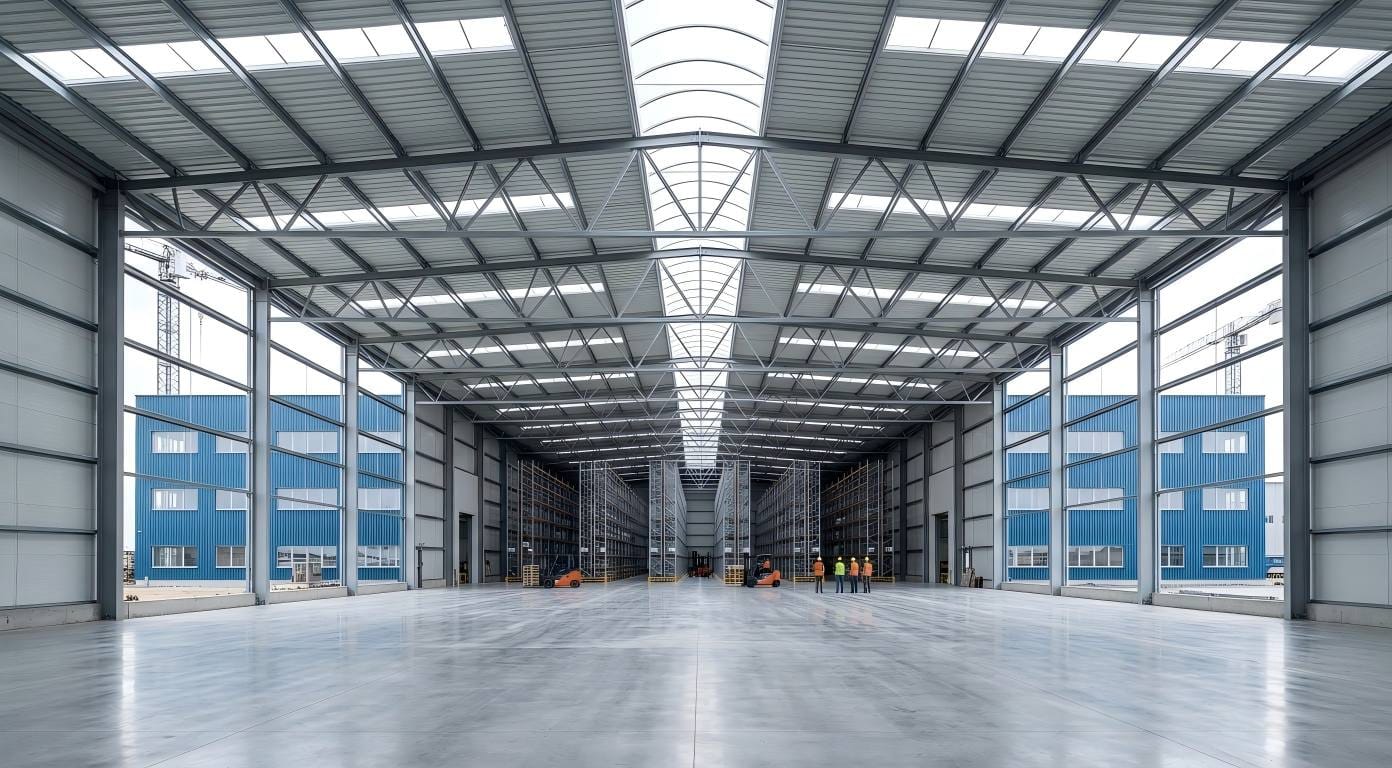
For example:
- A warehouse may need clear space for storage racks and forklifts.
- A factory may need flexible production line arrangement.
- A workshop may require overhead cranes or heavy equipment.
- A logistics building may need open loading and unloading areas.
- An aircraft hangar may require a very large door opening and column-free space.
Steel frames can be designed as portal frames, truss structures, multi-span frames, or customized structural systems depending on the building size, load requirements, and local design code.
Common Clear-Span Applications
| Building Type | Space Requirement | Steel Structure Benefit |
|---|---|---|
| Warehouse | Open storage and racking layout | Fewer internal columns |
| Workshop | Equipment movement and maintenance space | Flexible bay design |
| Factory | Production line arrangement | Adjustable column spacing |
| Aircraft hangar | Large door opening and clear width | Long-span structural solution |
| Sports hall | Open activity area | Wide-span roof structure |
| Logistics center | Fast goods movement | Better traffic flow inside the building |
A clear-span design may use more steel than a building with internal columns, so the right span should be selected based on both function and cost. For many owners, the increased usable space and operational efficiency can justify the structural investment.
3. Better Quality Control in Factory Fabrication
Another important advantage of steel structure buildings is that much of the work happens in a controlled factory environment. Compared with heavy site fabrication, factory production can provide better control over dimensions, welding, drilling, and surface treatment.
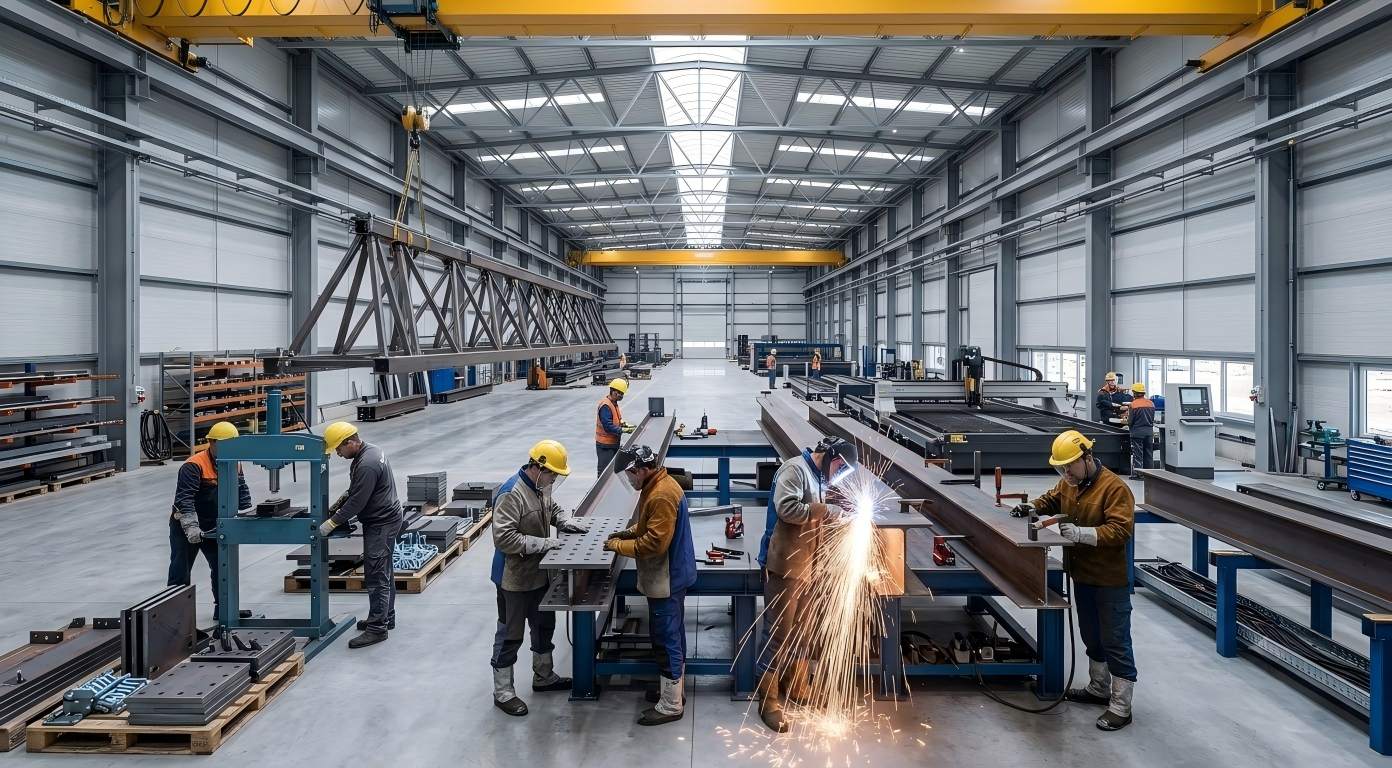
For export steel structure projects, quality control is especially important because any fabrication error can become expensive after shipment. A reliable manufacturer should control the process before loading containers.
Key Quality Control Points
| QC Item | What Should Be Checked | Why It Matters |
|---|---|---|
| Raw material | Steel grade, thickness, certificates | Ensures compliance with project requirements |
| Cutting | Length, angle, edge quality | Affects fit-up and assembly |
| Welding | Weld size, appearance, defects | Affects structural performance |
| Drilling | Hole diameter and position | Affects bolt connection accuracy |
| Assembly | Member dimensions and alignment | Reduces site erection problems |
| Surface treatment | Blasting grade, paint thickness, galvanizing quality | Improves corrosion protection |
| Marking | Member number, orientation, project zone | Helps site installation |
| Packing | Protection, sequence, small parts management | Reduces shipping and unloading risk |
Industry standards and inspection procedures for structural steel fabrication commonly include checks for welding, dimensions, materials, and connection preparation before shipment2. For overseas buyers, requesting inspection photos, packing lists, material certificates, and production progress updates can reduce project risk.
4. Easier Future Expansion and Modification
Many industrial buildings are not built only for today’s operation. Owners may need more storage space, new production lines, crane upgrades, mezzanine floors, or additional equipment in the future. Steel structure buildings are suitable for this type of planning because they can be designed with expansion in mind.
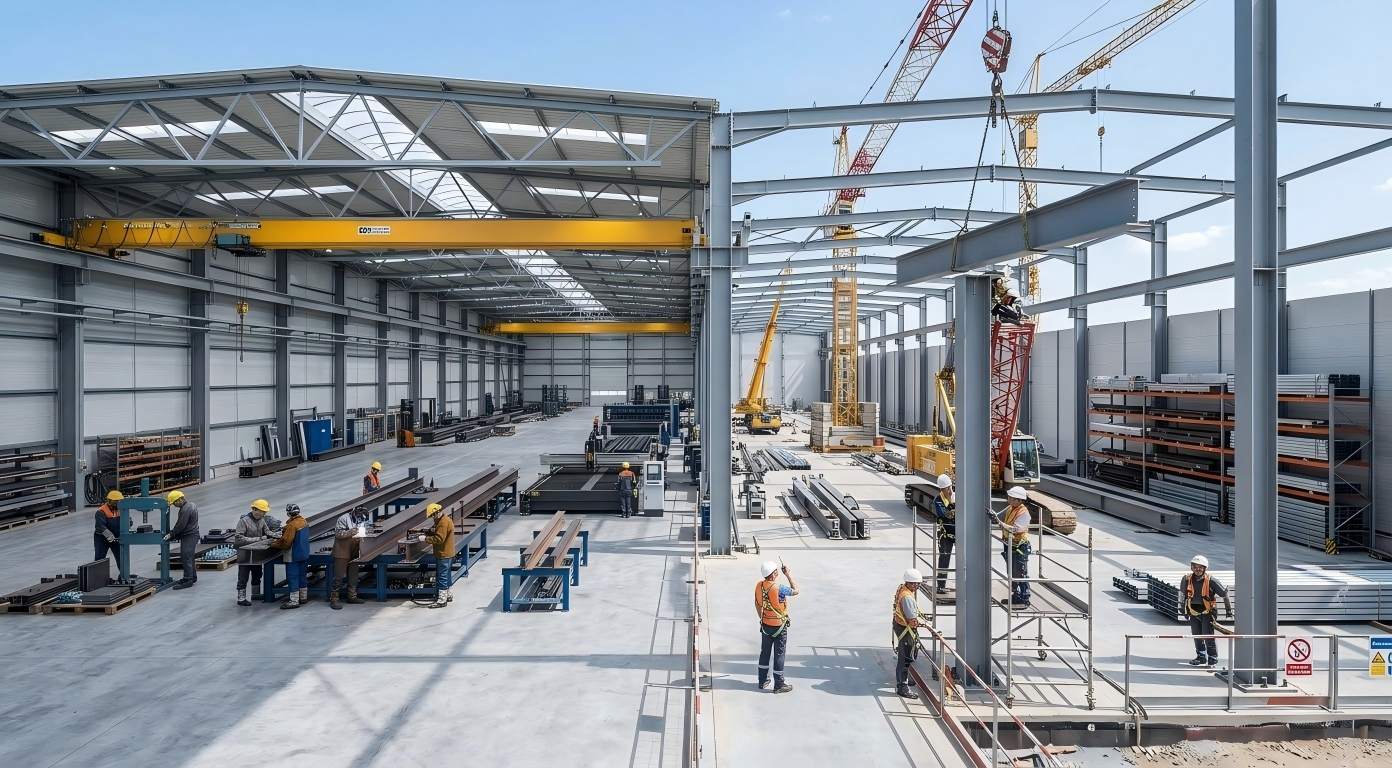
Future expansion should be considered during the initial design stage. It is much easier and more cost-effective to prepare for expansion before fabrication than to change the building after installation.
Expansion Planning Options
| Future Requirement | Design Consideration |
|---|---|
| Add more bays later | Plan end wall frame and connection details |
| Extend warehouse length | Keep column grid and roof system compatible |
| Add mezzanine floor | Check floor load and column capacity |
| Install overhead crane | Design crane beam, brackets, and frame load from the beginning |
| Add equipment platform | Reserve structural support points |
| Modify wall openings | Coordinate bracing and frame stability |
| Upgrade insulation | Select suitable wall and roof cladding system |
Steel structures can be modified, but every modification must be reviewed by qualified engineers. Cutting bracing, changing columns, or adding loads without structural review may create safety risks.
5. Shorter On-Site Work and Less Weather Dependency
Because many steel components are prefabricated, steel structure buildings can reduce some site work compared with more site-intensive systems. Less on-site cutting, welding, and wet work can help contractors manage labor, safety, and schedule.
This is especially valuable when:
- The local site labor cost is high
- Skilled welders are limited
- The construction schedule is tight
- Weather conditions affect site work
- The project location is remote
- The owner needs the building enclosed quickly
Steel erection still requires professional planning. Crane access, temporary bracing, anchor bolt accuracy, unloading space, lifting sequence, and worker safety must all be considered. Steel erection work should follow local safety regulations and approved erection procedures3.
Site Factors That Affect Installation Speed
| Site Factor | Why It Matters |
|---|---|
| Foundation accuracy | Anchor bolt errors can delay column installation |
| Crane access | Poor access increases lifting difficulty |
| Storage area | Components must be organized by erection sequence |
| Weather | Wind and rain can affect lifting operations |
| Labor skill | Experienced crews install faster and safer |
| Erection drawings | Clear drawings reduce confusion |
| Bolt availability | Missing bolts can stop installation |
A good steel structure supplier should not only fabricate the steel frame. It should also provide clear erection drawings, component labels, packing lists, and installation support documents.
6. Potential Foundation Benefits from Lower Structural Weight
Steel has a high strength-to-weight ratio. In many building designs, steel frames can be lighter than some alternative structural systems. A lighter superstructure may help reduce foundation loads, depending on the building design, soil condition, local code, and loading requirements4.
However, this should not be oversold. Foundation cost depends on many factors, including:
- Soil bearing capacity
- Building height
- Wind load
- Seismic requirements
- Crane load
- Column reactions
- Local foundation practice
- Geotechnical report
For this reason, the final foundation design should always be checked by a local licensed engineer. A steel structure manufacturer can provide column reactions and anchor bolt layout, but local engineering approval is still required.
7. Good Suitability for Warehouses, Factories, and Workshops
Steel structure buildings are widely used for warehouses, factories, workshops, and industrial facilities because these buildings often require open space, fast construction, and practical cost control.
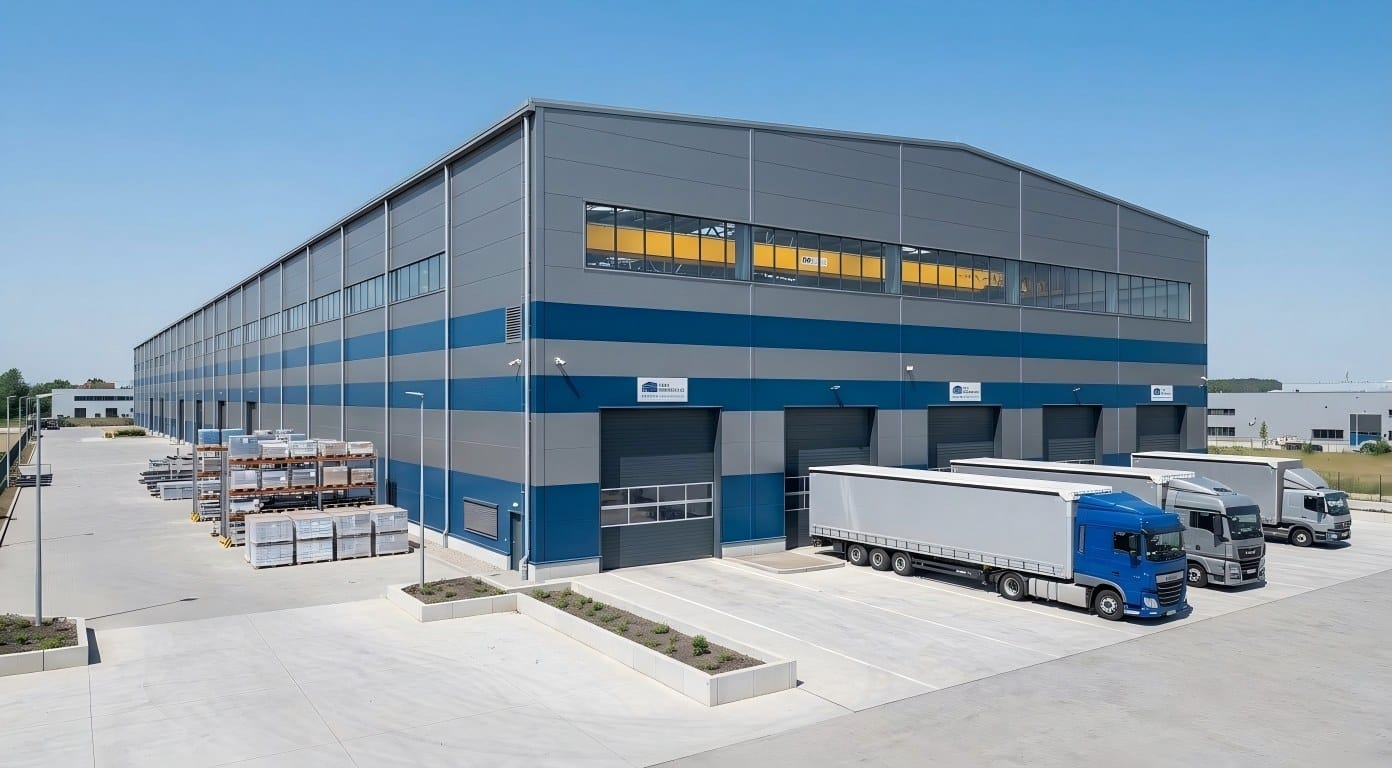
Typical Steel Structure Building Applications
| Application | Common Requirements | Why Steel Structure Fits |
|---|---|---|
| Warehouse | Large storage area, fast enclosure, loading doors | Clear span and quick installation |
| Factory | Production lines, equipment, possible crane system | Custom structural design |
| Workshop | Open working area, ventilation, maintenance access | Flexible layout and durable frame |
| Logistics center | Large open area, high traffic flow | Wide span and efficient space use |
| Cold storage | Insulated envelope, controlled temperature | Steel frame with insulated panels |
| Agricultural building | Cost control and large covered space | Simple frame and fast assembly |
| Aircraft hangar | Large clear opening | Long-span steel structure |
| Equipment platform | Additional working space | Custom steel platform solution |
For projects that need future extension, steel structures are often easier to plan in phases. For example, a warehouse can be designed so that additional bays can be added later with less disruption to existing operations.
8. Steel Structure vs Concrete: Practical Comparison
Steel and concrete are both important building systems. The best choice depends on project use, local cost, schedule, fire requirements, engineering approval, and site conditions.
Steel structure buildings are often preferred when speed, large span, prefabrication, and future flexibility are important. Concrete may be preferred where local materials are cheaper, fire rating requirements are easier to meet with concrete assemblies, or the project requires heavy mass and stiffness.
| Comparison Item | Steel Structure Building | Concrete Building |
|---|---|---|
| Construction speed | Often faster due to prefabrication | Often slower due to formwork, curing, and site work |
| Clear span | Very suitable for large-span spaces | May require larger members or more columns |
| Site labor | More work moved to factory | More work usually done on site |
| Future modification | Easier in many cases with engineering review | Modification can be more difficult |
| Fire protection | May need fireproofing or protected assemblies | Often has inherent fire resistance from mass and cover |
| Foundation load | Can be lighter in many cases | Often heavier |
| Quality control | Many components inspected before shipment | Site quality depends heavily on local process |
| Best use cases | Warehouses, workshops, factories, hangars | Residential towers, heavy cores, fire-rated structures |
Structural steel loses strength at high temperatures, so fire protection must be designed according to local codes and project requirements5. Fireproofing, intumescent coating, fire-rated cladding, sprinkler systems, and compartment design may all be part of the final solution.
9. Cost Factors Beyond Steel Price Per Ton
Many buyers first ask for the steel structure price per ton. This is understandable, but the ton price alone does not show the full project cost. Two buildings with the same floor area may have very different steel weight, fabrication complexity, coating requirements, and shipping cost.
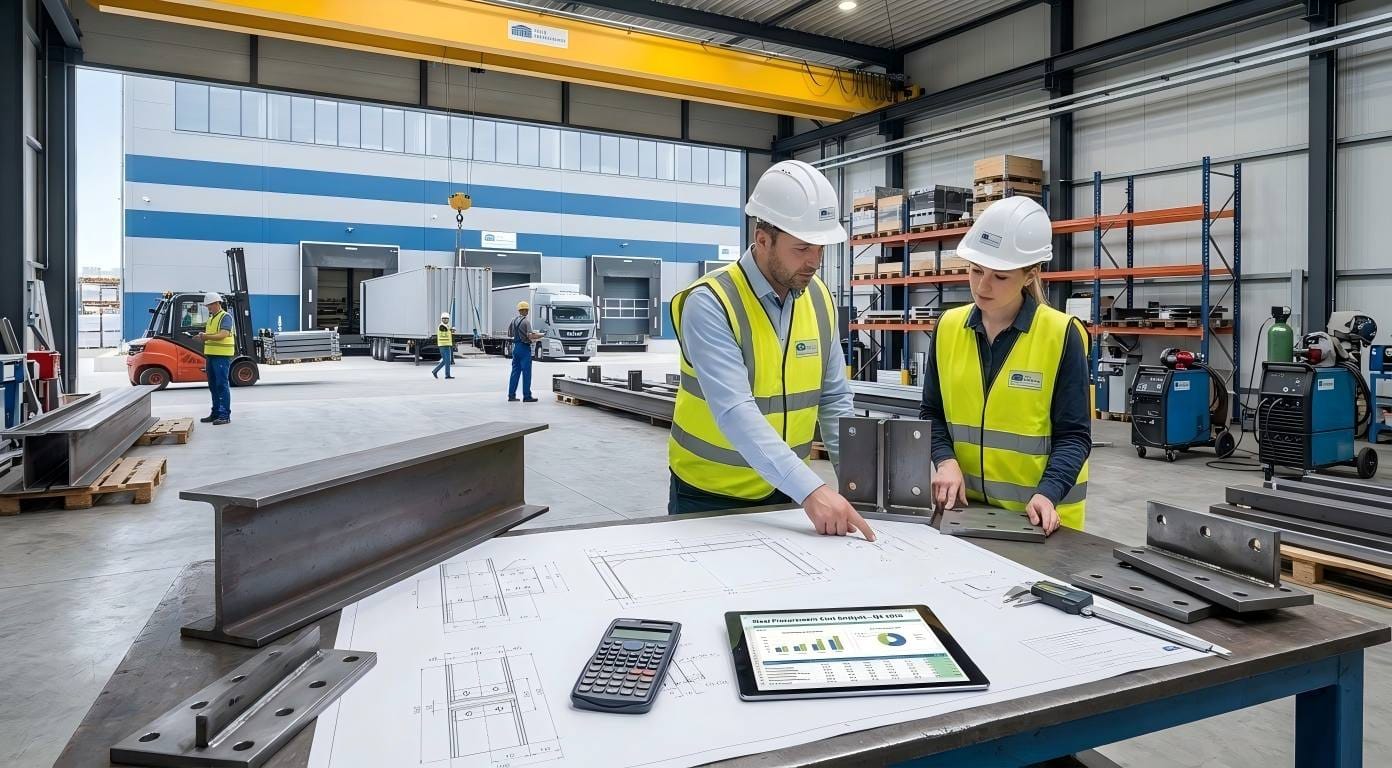
Main Cost Factors
| Cost Factor | How It Affects Price |
|---|---|
| Building size | Length, width, height, and clear height affect steel quantity |
| Span | Larger spans usually require stronger frames |
| Wind load | Higher wind load increases structural demand |
| Snow load | Roof members may need to be heavier |
| Seismic requirement | Connections and bracing may become more complex |
| Crane system | Crane beams, brackets, and frame reinforcement add cost |
| Mezzanine or platform | Additional floor beams and columns are required |
| Roof and wall cladding | Sandwich panels cost more than single steel sheets |
| Insulation | Thermal performance requirements affect envelope cost |
| Surface treatment | Painting, galvanizing, or special coating changes cost |
| Fire protection | Fire rating requirements may add fireproofing cost |
| Shipping | Container loading efficiency affects freight cost |
| Installation | Local labor, crane, and site conditions affect total cost |
A transparent quotation should clearly explain what is included and excluded. For overseas projects, packing, container loading, shipping documents, and component marking are also important parts of the supply scope.
10. Corrosion Protection and Long-Term Maintenance
Steel structure buildings can have a long service life when they are properly designed, protected, and maintained. Corrosion protection is especially important in coastal, humid, industrial, or chemical environments.
Common protection methods include:
- Shot blasting or sandblasting
- Anti-rust primer
- Epoxy coating systems
- Polyurethane topcoat
- Hot-dip galvanizing
- Regular inspection and maintenance
- Proper roof drainage and gutter design
International corrosion protection standards, such as the ISO 12944 series, provide guidance for protective paint systems based on environmental corrosivity and expected durability6.
Corrosion Risk by Environment
| Environment | Corrosion Risk | Suggested Consideration |
|---|---|---|
| Dry inland area | Lower | Standard primer and paint may be suitable |
| Humid climate | Medium | Better coating system and maintenance plan |
| Coastal area | High | Stronger anti-corrosion system or galvanizing |
| Chemical plant | High | Special coating system required |
| Agricultural building | Medium to high | Ventilation and corrosion-resistant materials |
| Cold storage | Special risk | Condensation control is important |
The correct surface treatment should be selected based on project location, humidity, chemical exposure, design life, and maintenance plan.
11. Roof, Wall, Insulation, and Building Performance
The steel frame is only one part of the building. Roof and wall systems also affect energy use, comfort, condensation control, and long-term operation.
For warehouses and factories, common envelope options include:
- Single steel sheet
- Steel sheet with fiberglass insulation
- EPS sandwich panel
- Rock wool sandwich panel
- PU/PIR sandwich panel
- Skylight panels
- Ventilation louvers
- Ridge vents
- Gutters and downpipes
Climate has a major impact on insulation, ventilation, moisture control, and energy performance7. A building in a hot climate may need heat insulation and ventilation. A cold storage building needs careful thermal bridge and condensation control. A coastal building needs stronger corrosion protection.
12. When Is a Steel Structure Building the Best Choice?
Steel structure is not the best answer for every project. It is usually a strong choice when the project has one or more of the following conditions:
| Project Condition | Steel Structure Suitability |
|---|---|
| Fast construction schedule | Very suitable |
| Large open space needed | Very suitable |
| Future expansion expected | Very suitable |
| Factory or warehouse use | Very suitable |
| Remote project site | Suitable if packing and logistics are well planned |
| High local labor cost | Suitable because more work is done in factory |
| Crane or equipment load | Suitable with correct structural design |
| Strict fire rating requirement | Suitable, but fire protection must be designed |
| Highly corrosive environment | Suitable with proper coating or galvanizing |
| Very heavy concrete core requirement | May need mixed structural system |
The best decision should be based on project use, local code, engineering review, total cost, construction schedule, and long-term operation.
Information Needed for a Steel Structure Building Quotation
To prepare an accurate proposal, a steel structure supplier needs more than only the building area. The more complete the project information, the more reliable the quotation will be.
Quotation Checklist
| Information Needed | Example |
|---|---|
| Building size | Length × width × eave height |
| Project location | Country, city, site condition |
| Building use | Warehouse, factory, workshop, hangar, cold storage |
| Design code | Local code, Eurocode, AISC, or other requirement |
| Wind load | If available from local engineer |
| Snow load | If applicable |
| Seismic requirement | If applicable |
| Crane requirement | Capacity, span, lifting height, working class |
| Mezzanine or platform | Load and layout |
| Roof and wall material | Steel sheet, sandwich panel, insulation type |
| Door and window layout | Roller doors, sliding doors, personnel doors, windows |
| Surface treatment | Painting, galvanizing, special coating |
| Fire protection | Required fire rating if any |
| Drawings | Architectural, structural, layout drawings if available |
| Destination port | For shipping cost estimate |
Need a Steel Structure Building Proposal?
We manufacture and export steel structure buildings for warehouses, factories, workshops, industrial facilities, and expansion projects.
If you are planning a steel structure project, send us your drawings or basic building information. Our engineering team can help you review:
- Steel frame solution
- Roof and wall cladding options
- Surface treatment
- Packing and shipping plan
- Preliminary quotation
- Component marking and delivery plan
Contact us to get a steel structure building proposal for your project.
FAQ About Steel Structure Building Advantages
Are steel structure buildings cheaper than concrete buildings?
Not always. Steel structure buildings may reduce total project cost when faster construction, lower site labor, large span, and future flexibility are important. However, concrete may be more economical in some local markets. The best comparison should include materials, labor, schedule, foundation, fire protection, maintenance, and local approval requirements.
How long does a steel structure building last?
A steel structure building can last for decades when it is properly designed, protected from corrosion, and maintained. Service life depends on the environment, coating system, drainage, maintenance, and building use.
Can steel structure buildings be expanded later?
Yes, steel structure buildings can often be expanded more easily than many traditional systems. However, future expansion should be considered during the original design. Column layout, end wall design, roof system, and frame capacity should be planned in advance.
Are steel structure buildings suitable for warehouses and factories?
Yes. Warehouses and factories are among the most common applications for steel structure buildings because they often need wide spans, flexible layouts, fast construction, and possible future expansion.
Do steel structure buildings need fire protection?
In many projects, yes. Fire protection depends on local building codes, occupancy type, required fire rating, and structural design. Common solutions include fireproof coating, intumescent paint, fire-rated boards, sprinkler systems, and protected assemblies.
What affects the cost of a steel structure building?
The main cost factors include building size, span, height, wind load, snow load, seismic requirement, crane system, steel weight, fabrication complexity, surface treatment, roof and wall materials, fire protection, shipping, and installation conditions.
Conclusion
Steel structure buildings offer important advantages for industrial and commercial projects, especially when the owner or contractor needs fast construction, large-span space, controlled fabrication quality, flexible layout, and future expansion.
The real value of a steel structure building is not only the steel price per ton. It comes from the full project process: design coordination, accurate fabrication, quality inspection, clear marking, proper packing, efficient shipping, and well-planned installation.
For warehouses, factories, workshops, logistics buildings, and expansion projects, a well-designed steel structure can help reduce project risk and improve long-term building usability.
"Why Steel", https://www.aisc.org/why-steel/. This source explains general advantages of structural steel, including strength, adaptability, speed, and sustainability. ↩
"Fabrication Inspection of Structural Steel Products", https://www.codot.gov/programs/bridge/bridge-manuals/fabrication_inspection_of_structural_steel_final-3_18_19.pdf. This document provides examples of fabrication inspection practices for structural steel products. ↩
"Steel Erection, 29 CFR 1926 Subpart R", https://www.osha.gov/laws-regs/regulations/standardnumber/1926/1926SubpartR. This regulation covers safety requirements related to steel erection work. ↩
"Geotechnical Engineering Circular No. 6: Shallow Foundations", https://www.fhwa.dot.gov/engineering/geotech/pubs/010943.pdf. This reference supports general foundation design principles and the importance of project-specific geotechnical and structural review. ↩
"Best Practice Guidelines for Structural Fire Resistance Design of Concrete and Steel Buildings", https://nvlpubs.nist.gov/nistpubs/technicalnotes/nist.tn.1681.pdf. This source explains fire resistance considerations for steel and concrete structures. ↩
"ISO 12944 — Paints and varnishes — Corrosion protection of steel structures by protective paint systems", https://www.iso.org/. ISO 12944 is a widely used standards series for selecting protective paint systems for steel structures in different corrosive environments. ↩
"Insulation and Building Envelope Guidance", https://www.energy.gov/energysaver/insulation. This source explains how climate, insulation, and building envelope decisions affect energy use and comfort. ↩
Comments