

How to Choose the Right Steel Structure Subcontractor?
Finding a reliable steel structure subcontractor can feel overwhelming. You're dealing with tight budgets, strict timelines, and technical requirements that can't afford mistakes. The wrong choice leads to delays, quality issues, and costly rework that eats into your profit margins1.
The right steel structure subcontractor should have proper certifications, proven project experience, and transparent quality control systems. They need reliable production capacity, strong documentation practices, and the financial stability to support your project from start to finish.

Over my 15 years in this industry, I've seen contractors make both brilliant and disastrous subcontractor choices. The difference usually comes down to asking the right questions upfront. Let me walk you through what really matters.
What Certifications Should Your Steel Structure Subcontractor Have?
You can't skip the paperwork on this one. Certifications tell you if a subcontractor can legally and safely work on your project.
Look for ISO9001 for quality management and region-specific standards like EN1090 for Europe, AISC for North America, or JIS for Japan2. These certifications prove the subcontractor meets recognized technical and safety standards for steel fabrication.
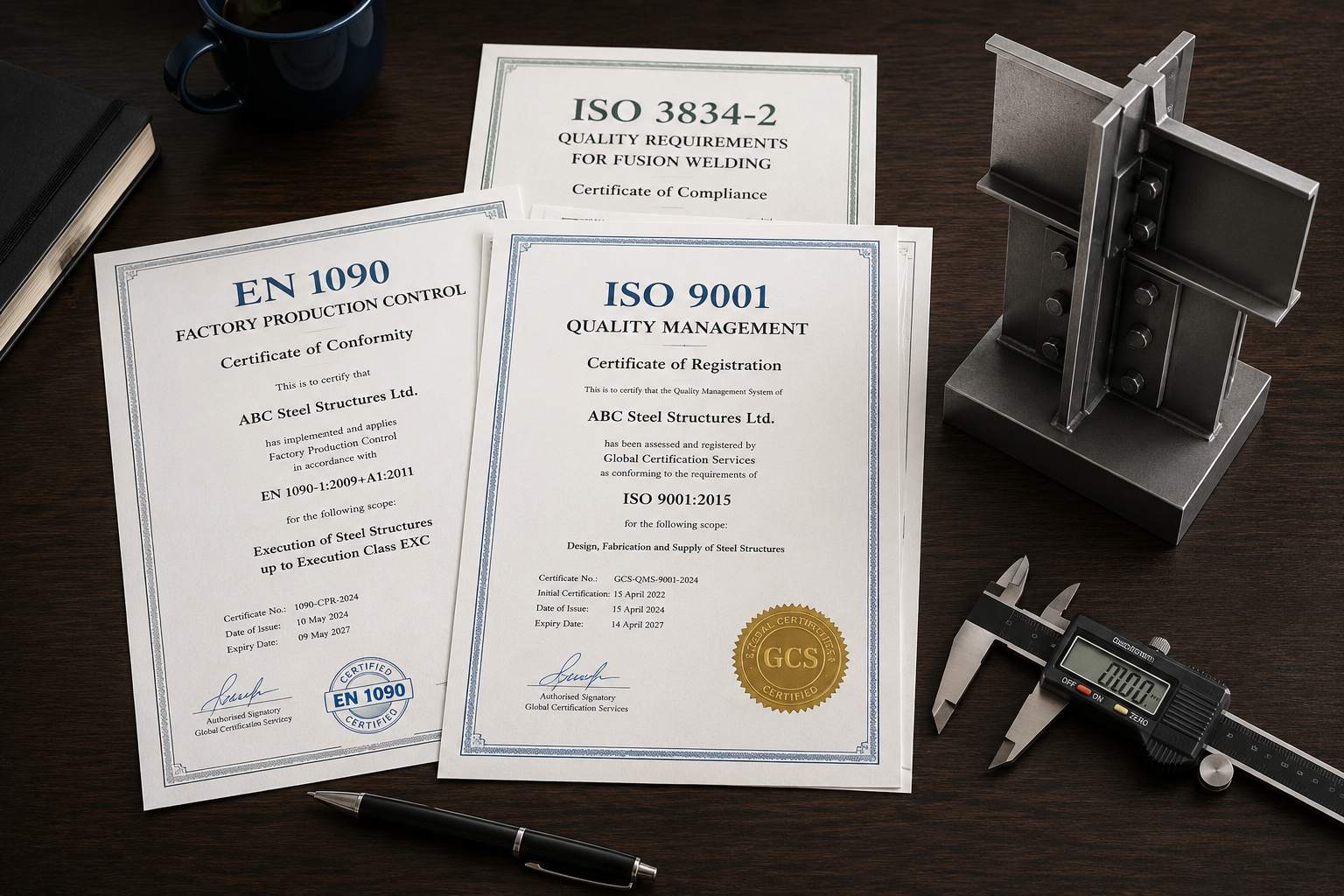
Different markets demand different standards. We hold ISO9001 and EN1090 because most of our clients work on European projects. But I've learned that certification alone doesn't guarantee performance.
Ask to see their actual certificates, not just claims on a website. Check the expiry dates. Call the issuing body if you're dealing with a large project. Some companies let certifications lapse or show certificates from sister companies that don't actually do the fabrication work.
Regional standards matter more than you might think. A subcontractor certified for European standards might struggle with American AWS welding requirements. The testing methods differ. The documentation formats differ. Even the steel grades have different naming systems.
| Region | Key Standards | Common Applications |
|---|---|---|
| Europe | EN1090, CE marking | Industrial buildings, commercial structures |
| North America | AISC, AWS | High-rise buildings, bridges |
| Russia | GOST | Heavy industrial facilities |
| Japan | JIS | Seismic-resistant structures |
| International | ISO9001 | Quality management baseline |
The certification should match your project location and requirements. Don't assume a good fabricator can work anywhere without the right credentials.
How Do You Verify Real Project Experience?
Anyone can claim experience. Smart contractors verify it.
Request detailed case studies with photos, project specifications, and client references. Look for projects similar to yours in scope, complexity, and structural requirements. Direct contact with previous clients gives you the most honest feedback.
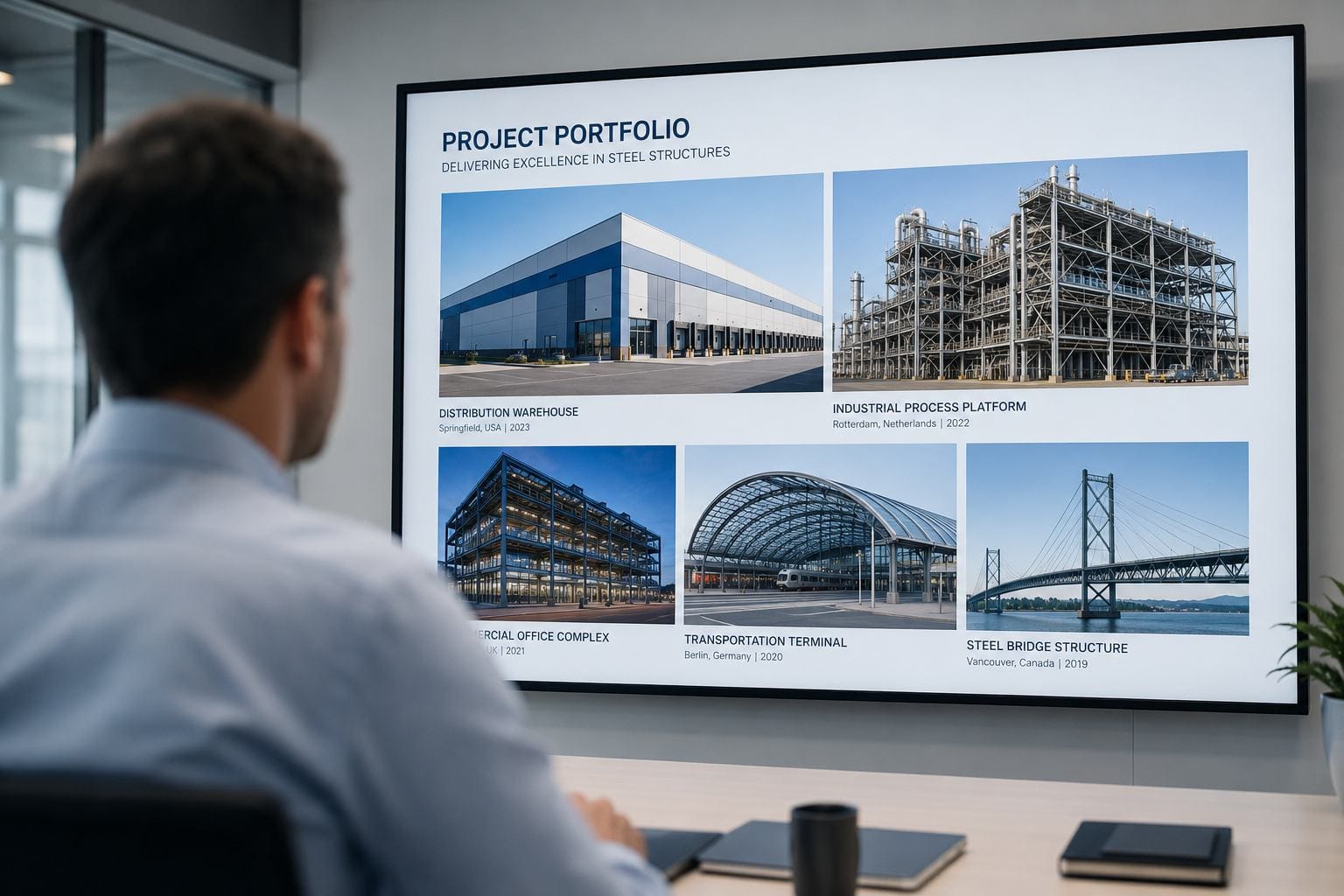
I always provide potential clients with our project portfolio. It includes warehouse structures, equipment platforms, and custom fabrication work. But I also know some companies pad their portfolios with projects they barely touched.
Ask specific questions about their role in past projects. Were they the main fabricator or a small sub-sub-contractor? What tonnage did they actually produce? What was the timeline? These details separate real experience from inflated claims.
Previous clients tell the truth that marketing materials won't. When you call references, ask about delivery performance, quality issues, and how the subcontractor handled problems. Every project has challenges. You want to know how they respond under pressure.
Look at project complexity too. A company that only makes simple portal frames might struggle with complex truss systems or curved structures. Match their proven capabilities to your technical requirements.
What Production Capacity Actually Matters?
Big facilities don't automatically mean better service. You need capacity that fits your project timeline.
Check annual production tonnage, number of production lines, workforce size, and equipment capabilities. The subcontractor should handle your project volume without compromising quality or delaying other clients.
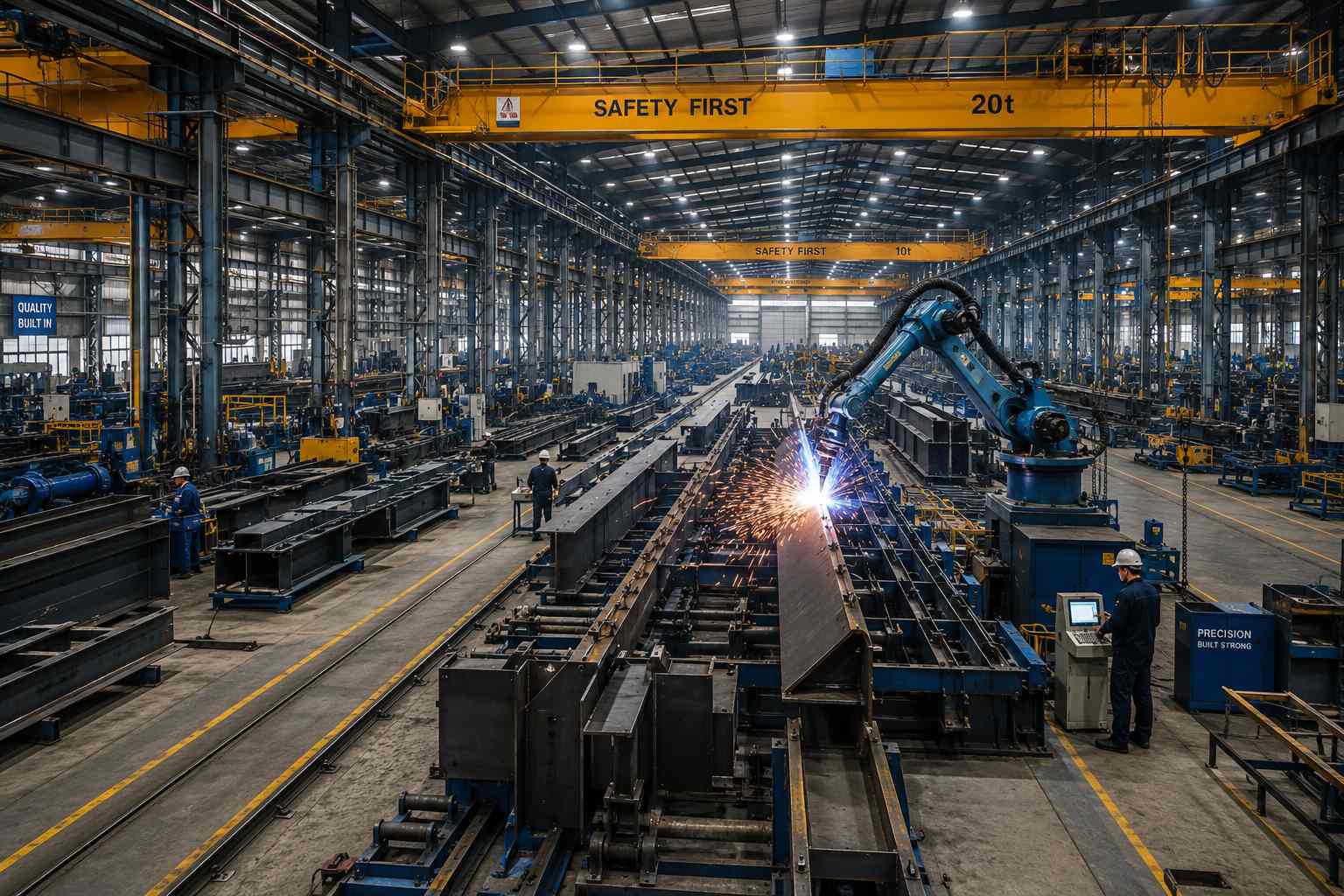
Our facility produces 15,000 tons annually with 100+ employees. This capacity works well for medium-sized projects and gives us flexibility for rush orders. But I've seen larger shops that couldn't deliver on time because they overbooked.
Visit the facility if possible. Photos can be misleading. Look at the actual production floor. Are machines running? Is the workspace organized? Do workers seem trained and focused? These observations tell you more than capacity numbers alone.
Equipment matters as much as space. Modern CNC cutting machines produce more accurate parts than manual cutting3. Automated welding systems provide consistent quality. Shot blasting and painting lines affect surface finish quality.
Ask about their typical project load. A facility running at 90% capacity year-round might not have room for your project. You want a subcontractor with enough capacity to handle unexpected challenges without making excuses.
Why Does Quality Control Need Third-Party Verification?
Internal quality checks help, but third-party verification protects you from problems.
Independent inspections from SGS, Bureau Veritas, or TÜV provide unbiased quality confirmation. Third-party factory audits verify that quality systems actually work in practice, not just on paper.
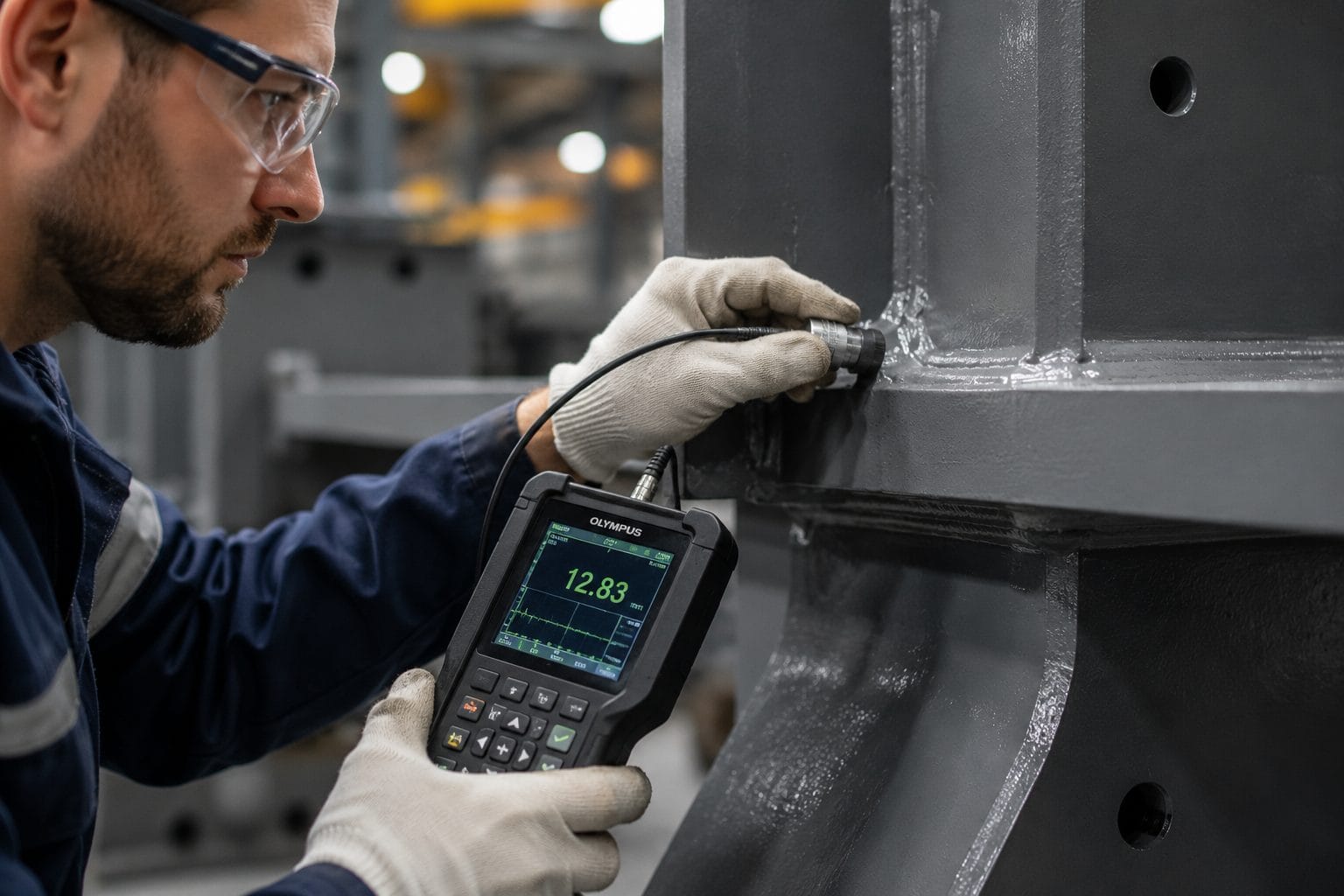
We welcome third-party inspections because they build trust. Clients can hire their own inspector or use a recognized inspection company. This transparency reduces disputes and proves we deliver what we promise.
Quality control should happen at multiple stages. Material inspection when steel arrives. Dimensional checks during fabrication. Welding inspection before and after. Surface treatment verification. Final inspection before shipping.4 Each checkpoint catches problems before they become expensive.
Third-party audits look deeper than individual inspections. They review your quality management system, training records, equipment calibration, and process controls. An audit verifies that the subcontractor has sustainable quality practices, not just good luck on one project.
Ask what happens when inspections fail. Good subcontractors have clear procedures for non-conformance. They identify root causes. They implement corrections. They track improvements over time.
How Important Is Material Traceability?
Material traceability protects you from counterfeit steel and proves code compliance5.
Every steel component should have documentation linking it back to the mill test certificate6. This traceability confirms material grades, chemical composition, and mechanical properties meet your specifications.
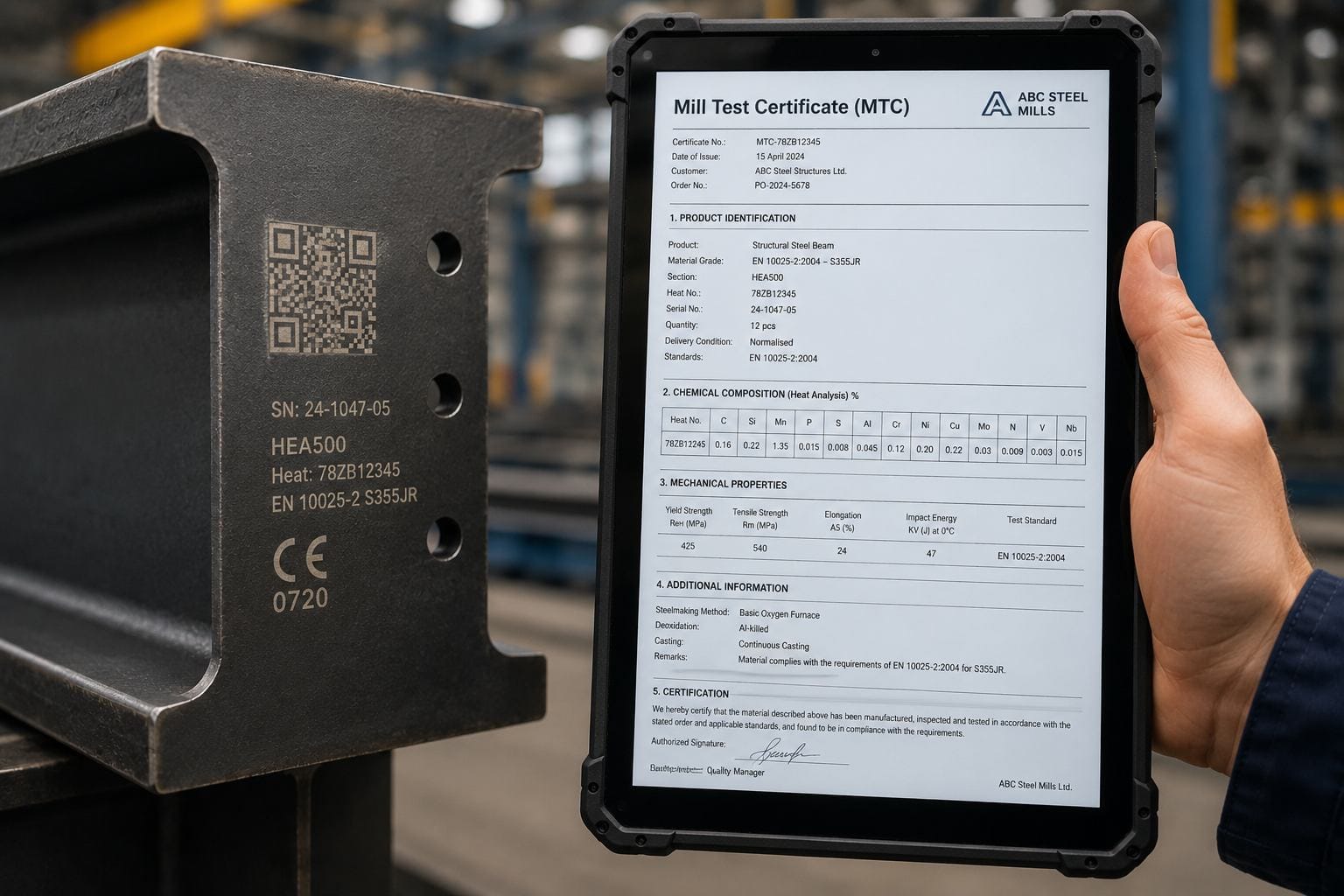
I've seen projects fail inspection because someone substituted cheaper steel grades. Material traceability prevents this. Each steel plate, beam, or section should have markings that connect to purchase orders and mill certificates.
Quality steel suppliers provide mill test certificates (MTCs) that show chemical analysis and mechanical testing results. Your subcontractor should organize these documents by project and component. When the inspector asks for material proof, the documentation should be ready immediately.
Some regions require specific steel grades with particular properties. European S355 steel differs from American A572 Gr50, even though they serve similar purposes7. The traceability system should flag any substitutions or grade changes before fabrication starts.
Digital documentation systems work better than paper files. They prevent lost certificates and make audits faster. We tag each component with a barcode that links to all relevant material documentation and fabrication records.
What Documentation Standards Should You Expect?
Good documentation prevents miscommunication and speeds up approvals.
Expect detailed fabrication drawings, welding procedures, material certificates, inspection reports, and as-built documentation. Digital file management systems should organize documents by project phase and component.
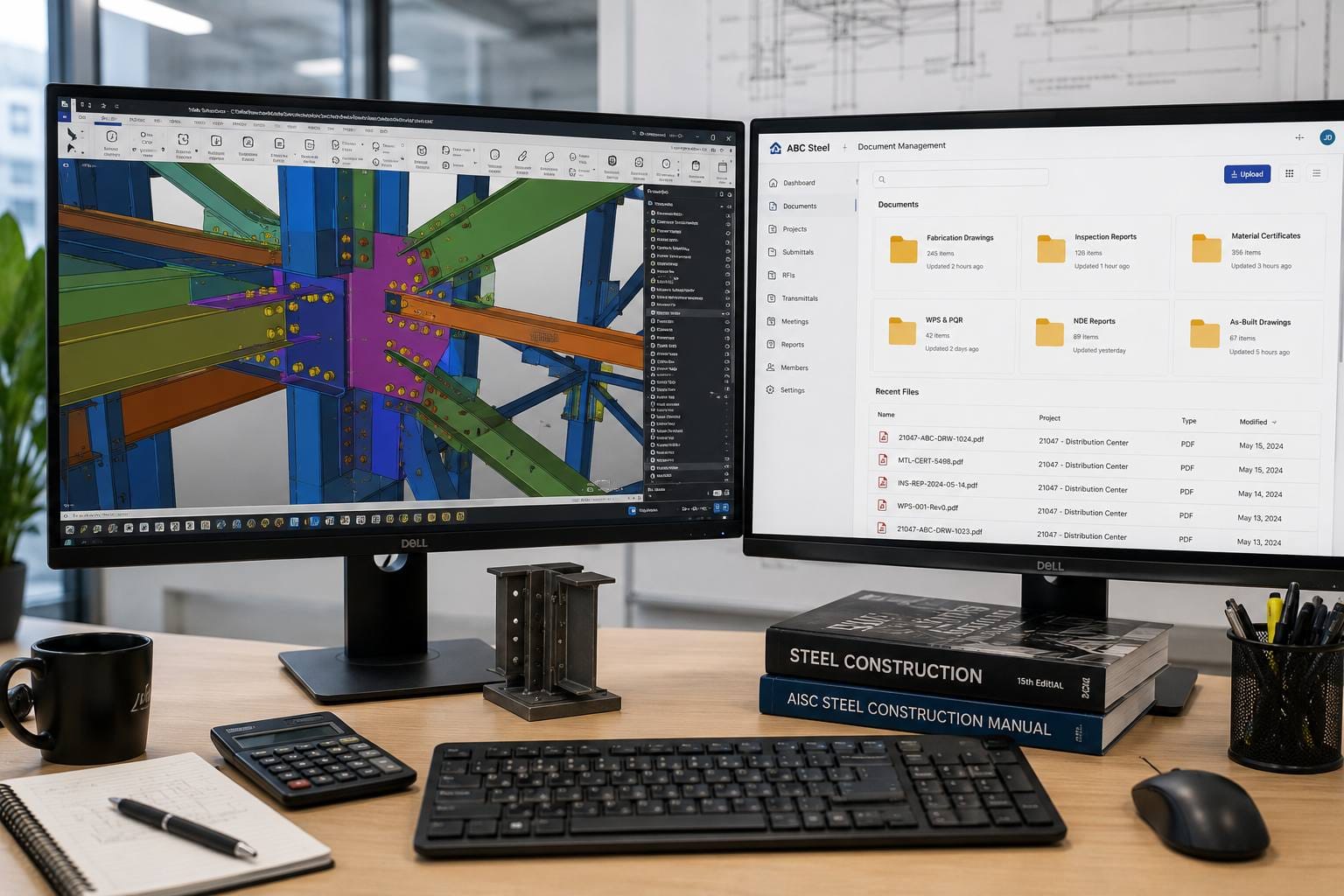
Documentation failures cause more problems than fabrication errors. A missing weld map delays inspection. Incorrect bolt specifications stop installation.8 Poor organization wastes everyone's time hunting for information.
Fabrication drawings should show every connection detail, weld type, and bolt specification. They need to match your engineering drawings but add the practical details that fabricators need. Any deviations from original designs require formal approval and documentation.
Digital file sharing beats email attachments. Cloud-based systems let multiple parties access current drawings and documents. Version control prevents people from working with outdated information. We use project management platforms that track document revisions and approval workflows.
As-built documentation matters more than most people realize. Projects always have small changes during fabrication or installation. Recording these changes creates accurate maintenance records and helps with future modifications.
How Do Logistics and Packaging Affect Your Project?
Poor packaging wastes money. Smart logistics save time.
Professional subcontractors plan container loading, design custom packaging for complex components, and coordinate shipping schedules with project timelines. They minimize damage risks and optimize freight costs.
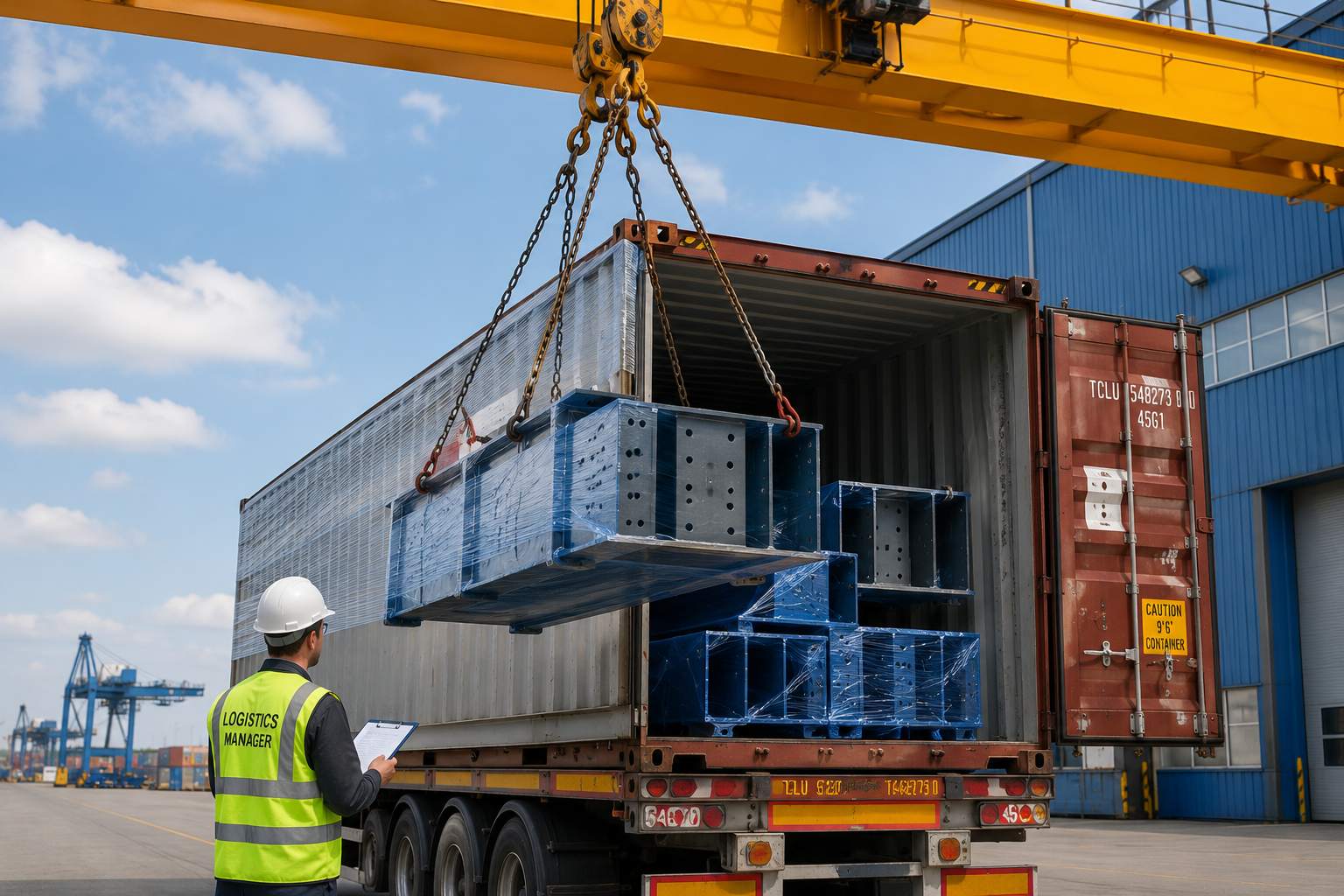
Shipping costs often equal 10-20% of the steel fabrication cost for international projects9. Efficient container loading reduces the number of containers you need. We use 3D modeling software to plan container layouts before production finishes.
Packaging protects your investment. We use wooden crates for finished surfaces, steel banding for bundles, and protective covers for painted components. The packaging method should match the component's fragility and the shipping conditions.
Coordinate shipping with installation schedules. Steel arriving too early creates storage costs and potential damage. Late delivery stops the entire project. Good subcontractors maintain buffer inventory and have backup logistics plans.
Export documentation requires attention to detail. Commercial invoices, packing lists, certificates of origin, and customs declarations must be accurate and complete. One missing document can delay customs clearance for weeks10.
Why Does Financial Health Matter?
A bankrupt subcontractor destroys your timeline and leaves you with unfinished work.
Review financial statements, check payment histories with suppliers, and verify business insurance coverage. Financially stable subcontractors can purchase materials promptly and maintain workforce stability throughout your project.

I've watched contractors lose deposits when subcontractors went bankrupt mid-project. The warning signs were there. Late payments to suppliers. Reduced workforce. Delayed material purchases. Financial stress shows up in project performance before companies actually fail.
Request basic financial information for large projects. Annual revenue. Years in business. Bank references. This information isn't invasive for legitimate companies. Resistance to basic financial disclosure raises red flags.
Payment terms tell you about financial health too. Subcontractors demanding large upfront payments might have cash flow problems. Reasonable payment structures spread risk and show financial confidence.
Insurance coverage protects both parties. Product liability insurance covers defects. Professional indemnity covers design errors if they provide engineering support. Workers' compensation protects against labor disputes.
What Contract Terms Protect Your Interests?
Contracts prevent disagreements and provide remedies when things go wrong.
Clear contracts should specify technical requirements, delivery schedules, payment terms, warranty coverage, liability limits, and dispute resolution procedures. Include inspection rights, change order processes, and termination conditions.

Generic contracts don't work for steel fabrication projects. Your contract needs technical specifications that reference drawings, material standards, and quality requirements. Vague language creates disputes later.
Delivery schedules should include penalties for delays and bonuses for early completion if timing matters. Make sure the contract accounts for reasonable delays like weather or shipping disruptions. Unrealistic penalties just increase the price.
Warranty terms need specific time periods and coverage scope. What defects does the warranty cover? How long does coverage last? Who pays for return shipping if repairs are needed? These details matter when problems surface six months after installation.
Change order procedures should be formal but efficient. Projects evolve. You need a documented process for approving scope changes, pricing adjustments, and timeline impacts. Informal change management leads to disputes.
What After-Sales Support Should You Expect?
Projects don't end when the steel ships. Good subcontractors stay involved.
Expect installation support, technical guidance for your erection crew, prompt response to field questions, and warranty service when needed. The best subcontractors treat after-sales support as relationship building.
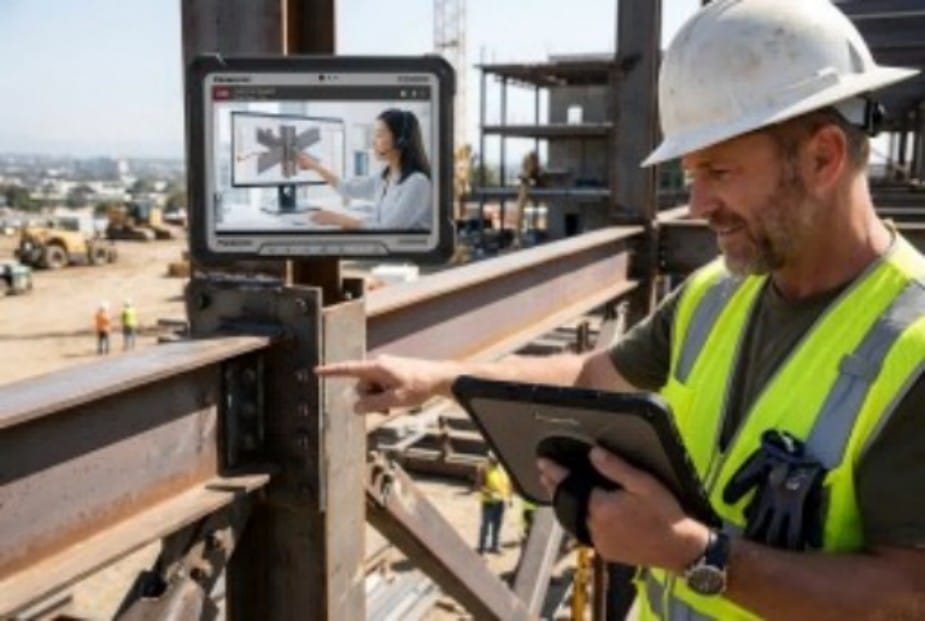
We provide installation manuals, erection sequences, and lifting point calculations. Our engineering team answers questions during installation. This support prevents problems and speeds up the construction process.
Response time matters during installation. A question about connection details shouldn't wait three days for an answer while crews sit idle. We commit to same-day responses for technical questions during normal business hours.
Warranty service should be straightforward. Clear reporting procedures. Quick assessment of the issue. Fair determination of responsibility. Prompt correction if the problem is our fault. This responsiveness shows whether a company stands behind their work.
Training for your installation crew helps projects run smoothly. We offer virtual or on-site training for complex connections or specialized components. This investment reduces installation errors and builds long-term relationships.
How Should You Think About Price?
The lowest price usually costs the most in the end.
Evaluate total project cost including quality risk, rework probability, delivery reliability, and logistics efficiency. Pay reasonable premiums for subcontractors with proven low-risk performance and transparent operations.
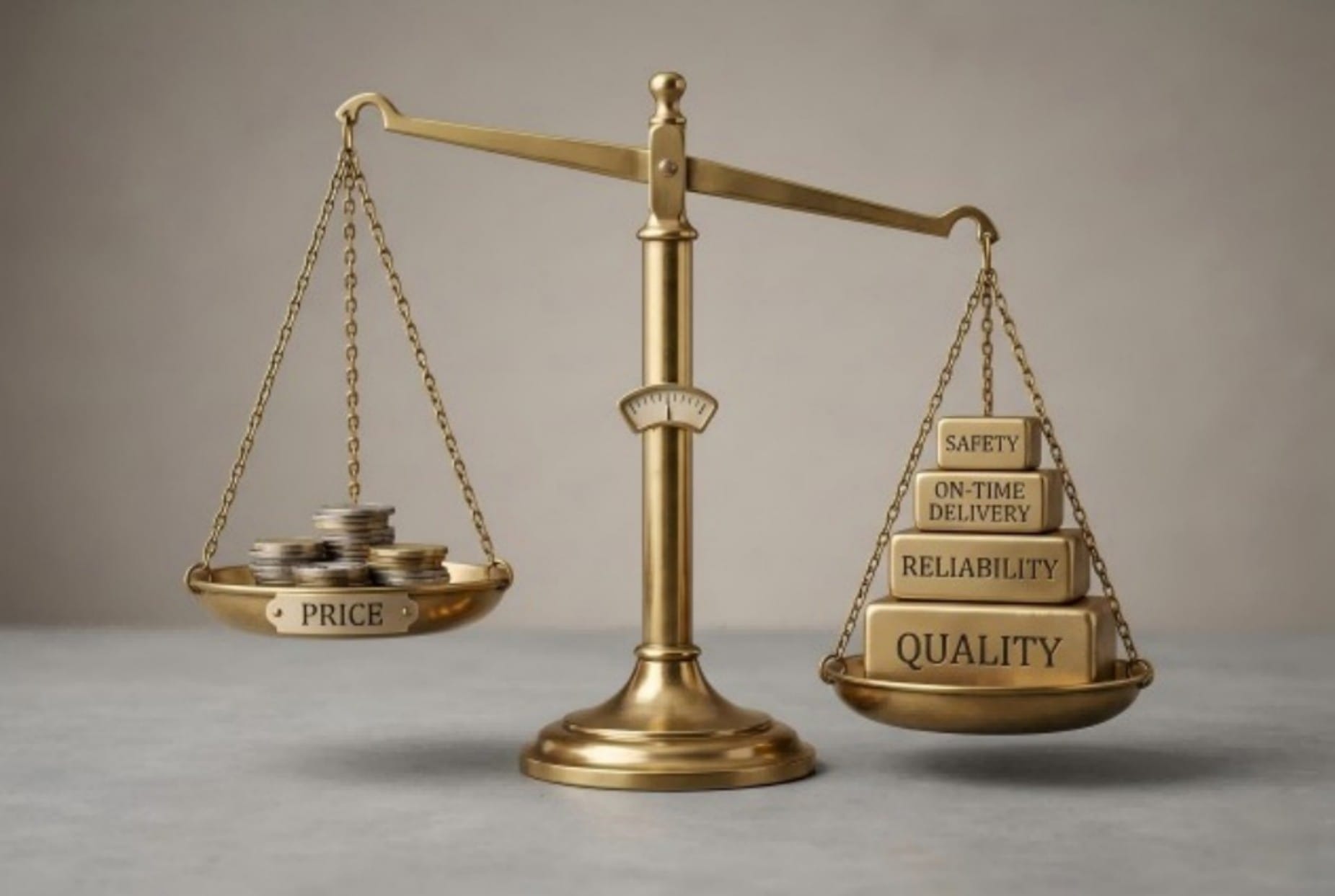
Price per ton doesn't tell the whole story. A cheap price with 20% rework doubles your installation time and labor costs11. Late delivery penalties can exceed the steel cost. One quality failure can damage your reputation with the end client.
Compare what's actually included in quotes. Does the price cover packaging? Are inspection costs separate? What payment terms apply? Lower prices sometimes hide costs that appear later as "extras."
| Cost Factor | Low-Price Risk | Quality Subcontractor Benefit |
|---|---|---|
| Rework Rate | 15-25% typical | 2-5% typical |
| Delivery Reliability | 60-70% on-time | 90-95% on-time |
| Documentation Quality | Incomplete/delayed | Complete/organized |
| Inspection Pass Rate | 70-80% first-time | 95%+ first-time |
| Communication Response | 2-3 days | Same day |
Calculate the total project risk. What does a one-week delay cost you in site overhead? What's the expense of flying someone back to fix installation problems? How much does poor documentation slow down inspections?
I'm biased, but I believe transparent pricing reflects honest business. Our quotes break down material costs, labor, processing, and logistics separately. Clients see exactly what they're paying for and can make informed value comparisons.
Conclusion
Choosing the right steel structure subcontractor requires thorough evaluation of certifications, proven experience, production capacity, quality systems, documentation practices, logistics capabilities, financial stability, and transparent pricing. The investment in proper selection saves money and headaches throughout your project.
"[PDF] Assessing the Costs Attributed to Project Delays", https://library.ctr.utexas.edu/hostedpdfs/tti/project-delay-summary.pdf. Construction management research documents that subcontractor performance significantly influences project delivery, with poor selection contributing to schedule delays and quality deficiencies that increase overall project costs. Evidence role: general_support; source type: research. Supports: that subcontractor selection affects project outcomes including delays and cost overruns. Scope note: This provides general support for the relationship between subcontractor selection and project outcomes, but does not quantify specific impacts on profit margins. ↩
"[PDF] Fabricated Structural Steel from Canada, China, and Mexico", https://www.usitc.gov/sites/default/files/publications/701_731/pub5031.pdf. ISO 9001 is an internationally recognized quality management standard applicable across industries including steel fabrication, while EN1090, AISC, and JIS represent region-specific structural steel execution and fabrication standards for Europe, North America, and Japan respectively. Evidence role: definition; source type: institution. Supports: the scope and recognition of ISO 9001, EN1090, AISC, and JIS as quality and fabrication standards. Scope note: This confirms the standards exist and their general purpose, but does not verify they are the only or most important certifications for steel subcontractors. ↩
"What is CNC Machining? - Goodwin University", https://www.goodwin.edu/enews/what-is-cnc/. Computer numerical control (CNC) systems achieve higher dimensional accuracy and repeatability than manual operations by eliminating human variability in tool positioning and movement, with typical tolerances in the range of ±0.1mm or better for steel cutting applications. Evidence role: mechanism; source type: education. Supports: that CNC machining provides higher precision than manual methods. ↩
"[PDF] Fabrication Inspection of Structural Steel Products", https://www.codot.gov/programs/bridge/bridge-manuals/fabrication_inspection_of_structural_steel_final-3_18_19.pdf. Quality management standards such as ISO 9001 establish that effective quality control requires inspection and verification at critical stages throughout the production process, including incoming materials, in-process checks, and final product verification. Evidence role: expert_consensus; source type: institution. Supports: that quality management systems employ inspection at multiple production stages. Scope note: This confirms multi-stage inspection as a quality management principle but does not specifically prescribe the exact stages listed for steel fabrication. ↩
"Anti-counterfeiting Solutions for Construction Materials - NanoMatrix", https://www.nanomatrixsecure.com/construction-old/. Construction standards and building codes require material traceability documentation to verify that materials meet specified grades and properties, with mill test certificates serving as primary evidence of material conformance. Evidence role: general_support; source type: government. Supports: that material traceability is important for quality assurance and compliance in construction. Scope note: This confirms traceability is a compliance requirement but does not provide specific evidence of its effectiveness in preventing counterfeit materials. ↩
"[PDF] 2021 Virginia Construction Code (PDF)", https://www.dhcd.virginia.gov/sites/default/files/DocX/building-codes-regulations/archive-codes/2021/2021-virginia-construction-code.pdf. Building codes and structural steel standards typically require that fabricators maintain material traceability through mill test certificates or certified material test reports that document the chemical and mechanical properties of steel components. Evidence role: expert_consensus; source type: government. Supports: that structural steel projects require material certification and traceability. ↩
"ASTM A572 Gr.50 vs S355J2, what's the difference? - LinkedIn", https://www.linkedin.com/pulse/astm-a572-gr50-vs-s355j2-whats-difference-phoebe-han-ya0qc. S355 (European EN standard) and A572 Grade 50 (American ASTM standard) are structural steel grades with similar minimum yield strengths (approximately 50 ksi or 355 MPa) but differ in their specific chemical composition requirements, testing protocols, and designation systems. Evidence role: mechanism; source type: education. Supports: that S355 and A572 Gr50 are comparable but distinct structural steel grades from different standards systems. ↩
"Resolving Discrepancies On Construction Projects", https://kp.uky.edu/knowledge-portal/articles/resolving-discrepancies-on-construction-projects/. Construction management studies identify incomplete or inaccurate documentation as a common source of project delays, rework, and coordination problems during fabrication and installation phases. Evidence role: general_support; source type: research. Supports: that documentation quality affects construction project efficiency. Scope note: This supports the general principle that documentation affects project flow but does not verify the specific examples of weld maps or bolt specifications. ↩
"[PDF] An Analytical Method to Estimate the Total Installed Cost of Steel ...", https://stacks.stanford.edu/file/druid:yb503ws4475/TR220.pdf. Industry analyses indicate that transportation and logistics can represent a significant portion of total material costs in international construction projects, with percentages varying based on distance, volume, and shipping methods. Evidence role: statistic; source type: research. Supports: the proportion of shipping costs relative to material costs in construction. Scope note: This confirms shipping represents a substantial cost component but does not verify the specific 10-20% range for steel fabrication. ↩
"I ordered goods from abroad, but the seller said they are being held ...", https://www.help.cbp.gov/s/article/Article-1171. Customs authorities require complete and accurate documentation for import clearance, and missing or incorrect documents result in shipment holds while issues are resolved, with delay duration depending on the specific document, jurisdiction, and correction complexity. Evidence role: general_support; source type: government. Supports: that incomplete or incorrect documentation causes customs clearance delays. Scope note: This confirms documentation affects customs processing but does not verify the specific timeframe of weeks for delays. ↩
"An Evaluation of Actual Costs of Rework and Scrap in Manufacturing ...", https://www.academia.edu/27432831/An_Evaluation_of_Actual_Costs_of_Rework_and_Scrap_in_Manufacturing_Industry. Construction industry research indicates that rework typically adds 5-20% to total project costs depending on severity, with costs including direct correction expenses, schedule delays, and productivity losses, though the specific impact varies by project type and rework extent. Evidence role: statistic; source type: research. Supports: that rework significantly increases construction project costs. Scope note: This confirms rework substantially increases costs but does not verify the specific claim that 20% rework doubles installation time and labor costs. ↩
Comments