Note: The design and installation for this project were completed by our Australian client.
- Client Background & Requirements
- Client: A mixed-use commercial complex in central Melbourne seeking to transform an open-air forecourt into an all-weather “Winter Garden” for year-round pedestrian comfort and brand visibility.
- Objectives:
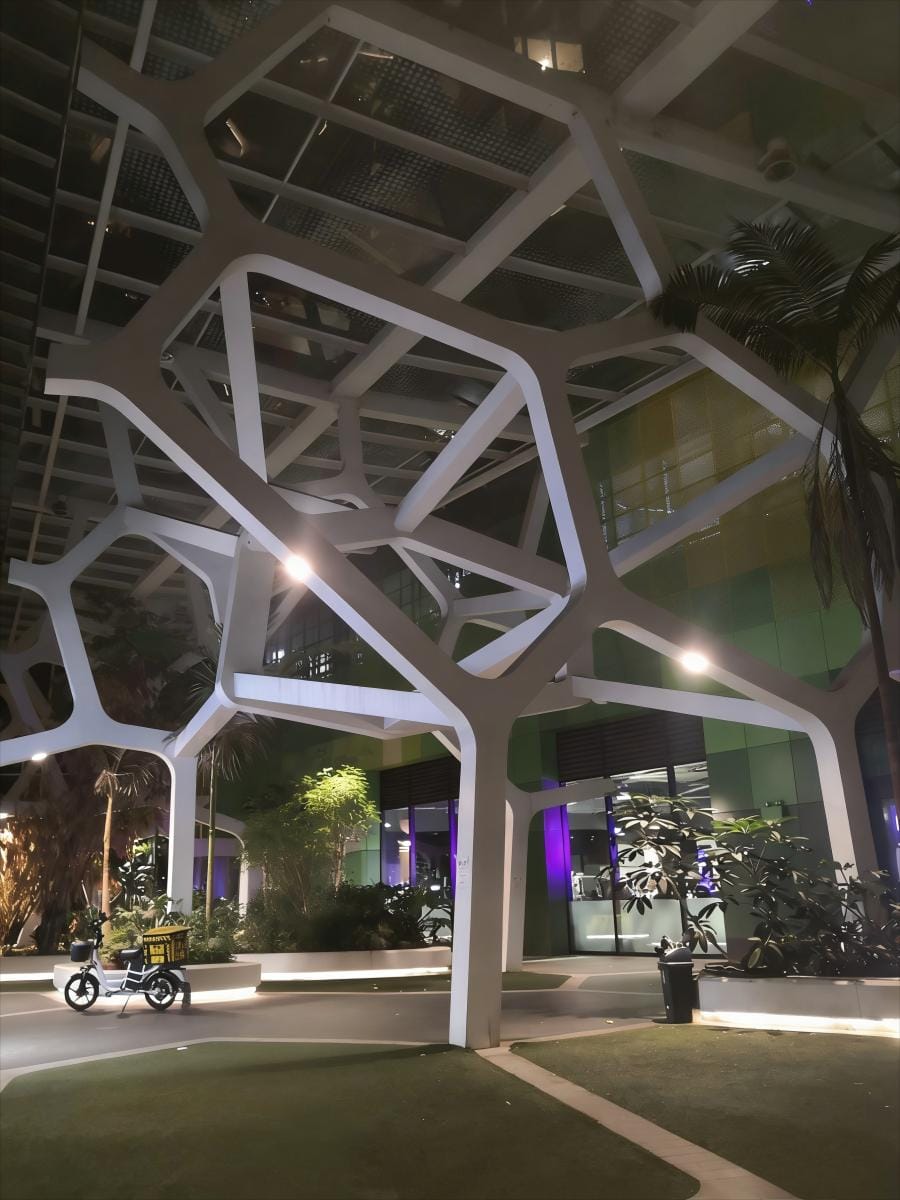
- Create a distinctive architectural steel canopy that blends with lush landscaping and existing green façade panels.
- Provide weather protection while maintaining daylight and transparency.
- Integrate concealed lighting for night-time activation without glare.
- Ensure fast-track delivery with minimal disruption to ongoing operations.
- Constraints:
- Tight urban site with continuous public access.
- Complex geometry requiring precise fit to existing building interfaces.
- Local compliance to Australian standards and coordination with glass/perforated metal roof elements.
- Design & Manufacturing Process
- Structural Concept
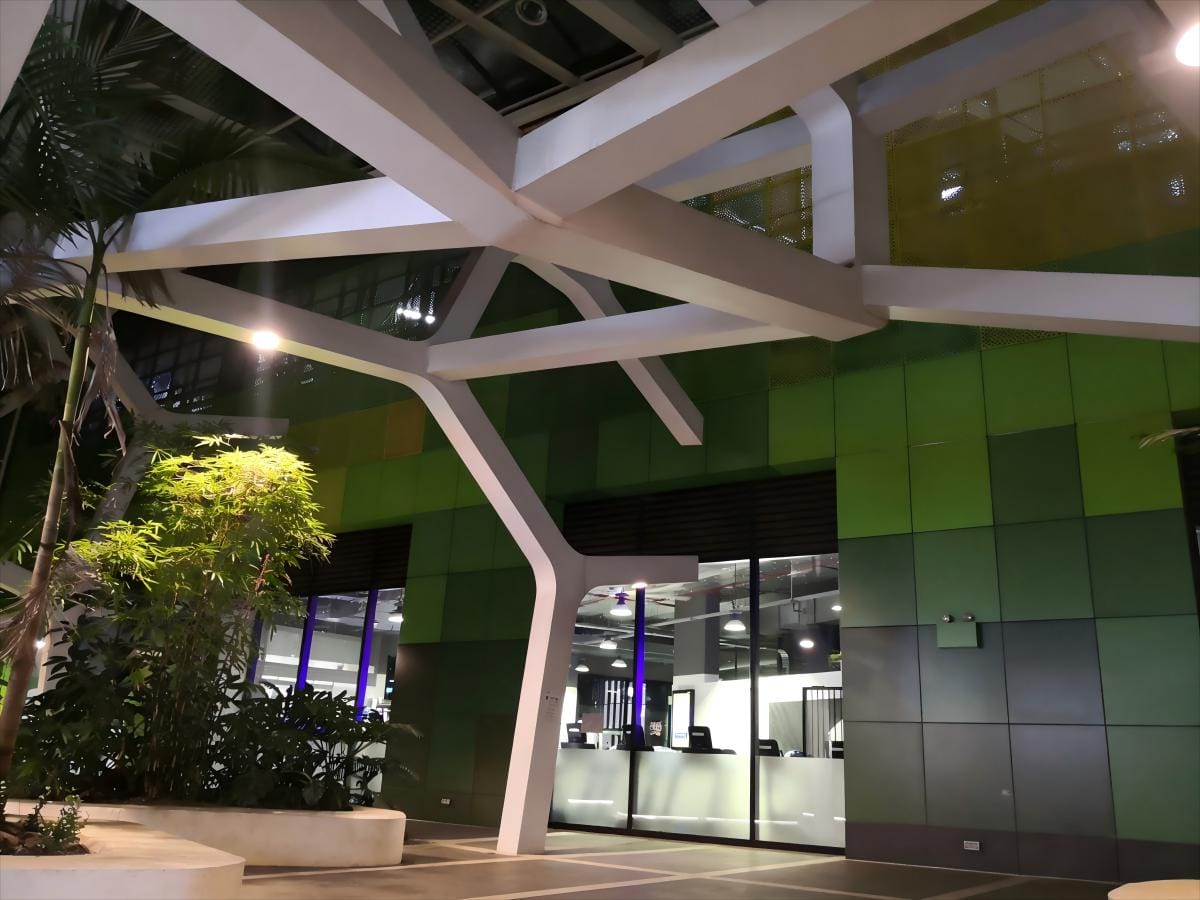
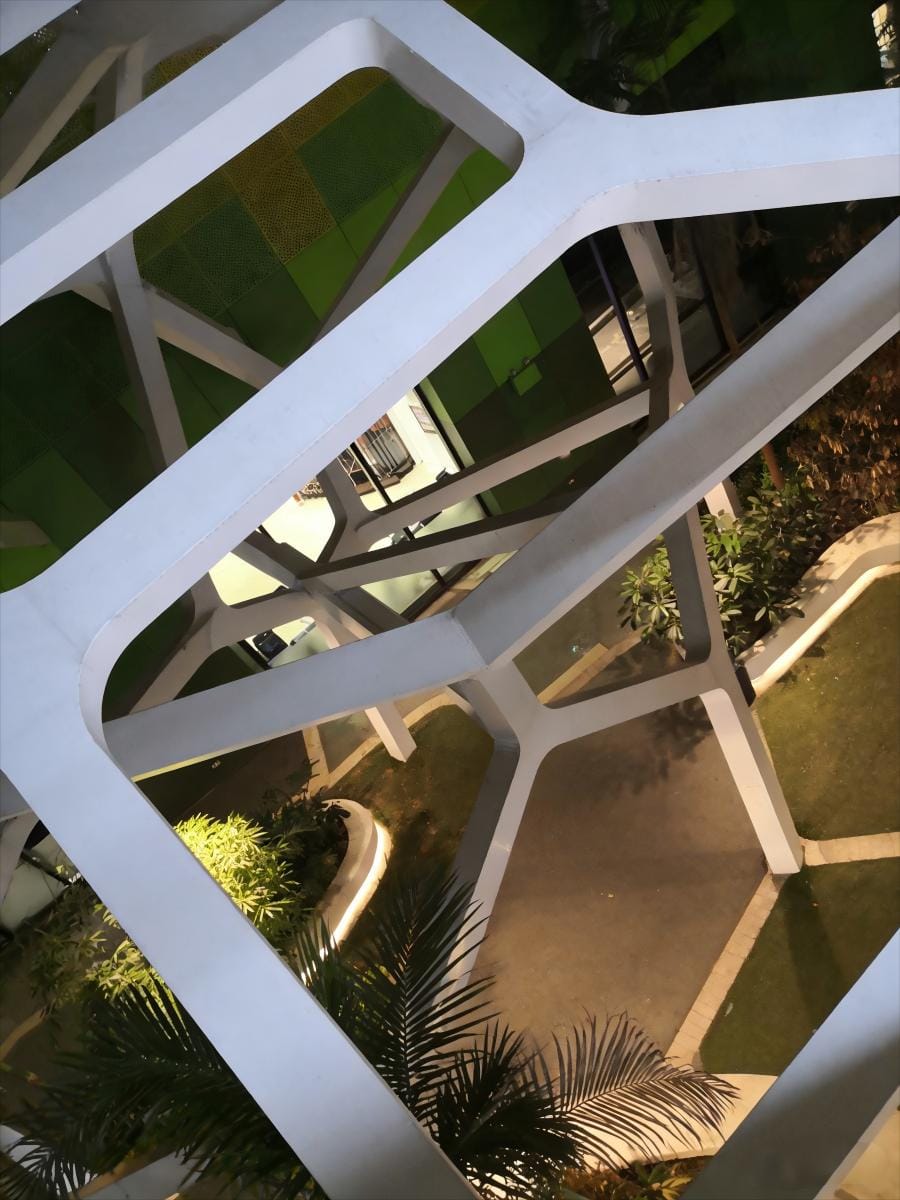
- System: Branching V-columns supporting a cellular space-frame canopy with hexagonal and pentagonal modules.
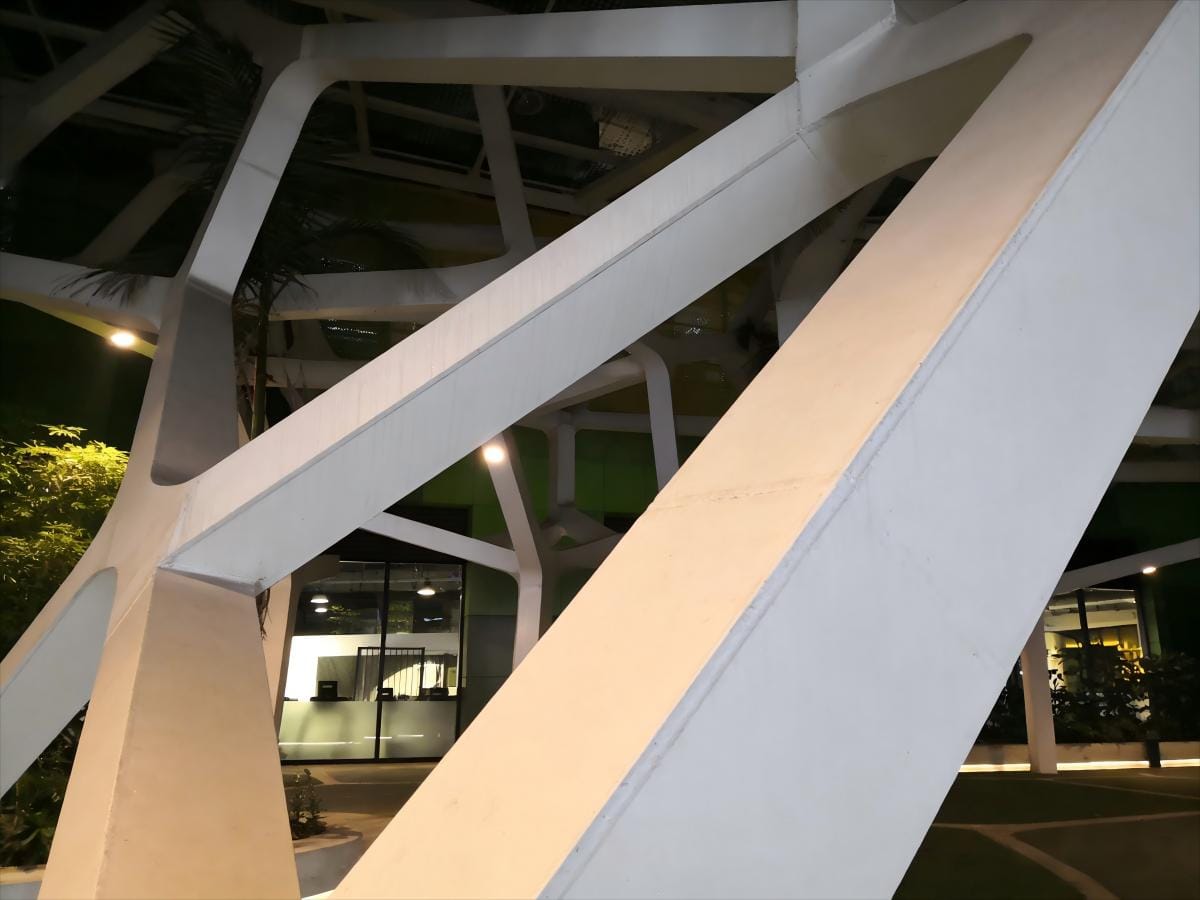
- Members: Welded box sections and tapered plate girders forming organic frames; hidden node connections for a clean architectural finish.
- Estimated dimensions:
- Canopy footprint: approximately 35 m × 25 m (circa 875 m²).
- Clear height under canopy: 6.0–8.0 m.
- Member depth: 300–450 mm; typical wall thickness 10–16 mm.
- Estimated steel tonnage: 65–85 metric tons for primary canopy and columns.
- Engineering & Standards
- Design software: Tekla Structures (3D detailing), STAAD.Pro/SAP2000 (global analysis), Rhino + Grasshopper (geometry rationalization), AutoCAD (shop drawings).
- Codes/standards: AS/NZS 1170 (loads), AS 4100 (steel structures), AS/NZS 3678/3679 (steel materials), AS/NZS 1554 (welding), AS 1627/AS 2312 (surface preparation and protection).
- Materials:
- Structural steel: Grade 300/350 per AS/NZS 3678 (plate) and 3679 (sections).
- Fasteners: High-strength structural bolts per AS/NZS 1252.
- Roof infill: Laminated safety glass panels combined with perforated aluminum screens for diffuse light and ventilation.
- Coating system:
- Shop blast to Sa 2.5, zinc-rich epoxy primer (75 μm), epoxy build coat (125 μm), polyurethane topcoat (50 μm), total DFT ≈ 250 μm.
- Color: Architectural matte white (near RAL 9016) to enhance nighttime luminance and contrast with the green façade.
- Detailing & Fabrication
- Node geometry: CNC-cut plate segments forming closed box nodes; full-penetration butt welds per AS/NZS 1554 SP.
- Tolerance control: 3D model-to-fabrication workflow with laser scanning of existing interfaces; trial assembly in shop for node fit verification.
- Concealed services: Cable trays within box members for LED uplights and downlights; access hatches at node locations.
- Logistics & Installation
- Packaging: Foam-protected node assemblies and members; corrosion-inhibiting wraps; serialized for sequence erection.
- Transport: Containerized sea freight to Melbourne; just-in-time delivery to minimize site storage.
- Erection: Night-time lifts using compact cranes and MEWPs; bolted base plates with chemical anchors to existing concrete; site welds limited to closure plates and minor trims.
- Program: 5 weeks on-site erection plus 1 week commissioning and lighting tests; public access maintained via phased cordon zones.
- Project Highlights & Features
- Iconic organic geometry
- The branching column-tree morphology creates a sculptural canopy with hexagonal cells that echo botanical forms and align with landscaped planters.
- Daylight and weather mediation
- A hybrid roof of laminated glass and perforated aluminum diffuses sunlight, reduces wind acceleration, and provides rain protection while retaining an open-air ambiance.
- Seamless integration
- Nodes and joints are visually calm—no exposed gussets—achieved through closed box fabrication and precision welding, delivering continuous, flowing edges.
- Night-time experience
- Integrated LED lighting washes the white steel surfaces, producing a soft glow that highlights the canopy’s cellular pattern and supports evening retail trade.
- Durability and maintenance
- High-build protective coatings and sealed box sections ensure long-term performance in an urban microclimate; maintenance access is discreetly planned.
- Safety and compliance
- Designed to AS standards with pedestrian load combinations, local wind climate, and differential movement allowances at façade interfaces.
- Results & Client Testimonials
- Performance outcomes
- Footfall uplift: 18–25% increase in evening pedestrian dwell time during cooler months (post-opening, client analytics).
- Tenant benefit: Improved café seating capacity under canopy and enhanced storefront visibility.
- Operational efficiency: Zero lost trading days during erection due to phased night works.
- Longevity: Coating system projected service life 15–20 years to first major maintenance, subject to routine inspection.